VAT Exemptions in the Philippines: How to Qualify, Document, and Avoid Costly BIR Disputes.
VAT Exemptions in the Philippines: How to Qualify, Document, and Avoid Costly BIR Disputes.

VAT exemptions sound simple until an audit asks you to prove the exact legal basis for every “exempt” sale.
Most conflicts start when a company relies on a general understanding of exemption, while the BIR applies the specific wording of Section 109 and the latest implementing rules.
Another common trigger is threshold-based exemption.
The EOPT Act reintroduced a mechanism to adjust the PHP3,000,000 VAT-exempt threshold every three years using the PSA consumer price index, which means businesses must pay attention not only to their sales figures but also to updated regulatory guidance.
Finally, documentation is everything.
Even when the underlying transaction is truly exempt, inconsistent invoices, weak contracts, or missing eligibility proofs can lead to reclassification, deficiency VAT, and penalties.

Send us an email with the details for
personalized recommendations or schedule a consulation if needed.
A VAT exemption is a transaction that the law removes from the VAT system, meaning no output VAT is charged on that sale, and input VAT attributable to that exempt sale is generally not creditable against output VAT.
The main statutory list of these transactions is found in Section 109 of the Tax Code, as amended by laws such as TRAIN, CREATE, and EOPT.
- VAT-exempt is different from zero-rated, which remains VAT-taxable at 0% and may allow input VAT refunds.
- Many exemptions apply automatically based on the nature of the good or service.
- Some exemptions depend on status, accreditation, or thresholds.
Action: List your “exempt” revenue streams and link each one to a specific Section 109 category before your next filing cycle.
Email admin@lawyerphilippines.org if you want a quick confirmation of the exact exemption category you should be using.
Section 109 covers a wide range of exempt transactions, but business disputes often cluster around a few high-impact areas: basic goods, education and health-related services, cooperatives, real estate, and threshold-based exemptions.
- Education services by accredited institutions are commonly treated as exempt, subject to the statutory and regulatory scope.
- Medical, dental, hospital, and veterinary services may be exempt under the law’s parameters, with distinctions often arising in practice.
- Cooperative transactions can be exempt if the cooperative is duly registered and the transaction falls within covered activities.
- Lease of residential units under the monthly threshold and qualified housing sales are frequent audit targets because of threshold computations.
Action: Identify your top three exemption-dependent revenue streams and build a dedicated evidence checklist for each one.
Businesses whose gross annual sales/receipts do not exceed the statutory VAT threshold may be exempt under Section 109(CC), with the EOPT framework providing for periodic CPI-based adjustments to keep the threshold current.
- This is one of the most litigated “practical exemptions” because it depends on accurate, auditable numbers.
- If you are not VAT-registered and are covered by the threshold exemption, you may be subject to the applicable percentage tax rules.
- The risk increases when companies hover near the threshold and do not monitor rolling 12-month totals.
Action: Set a monthly internal alert when your year-to-date sales hit 70%, 85%, and 95% of the prevailing threshold.
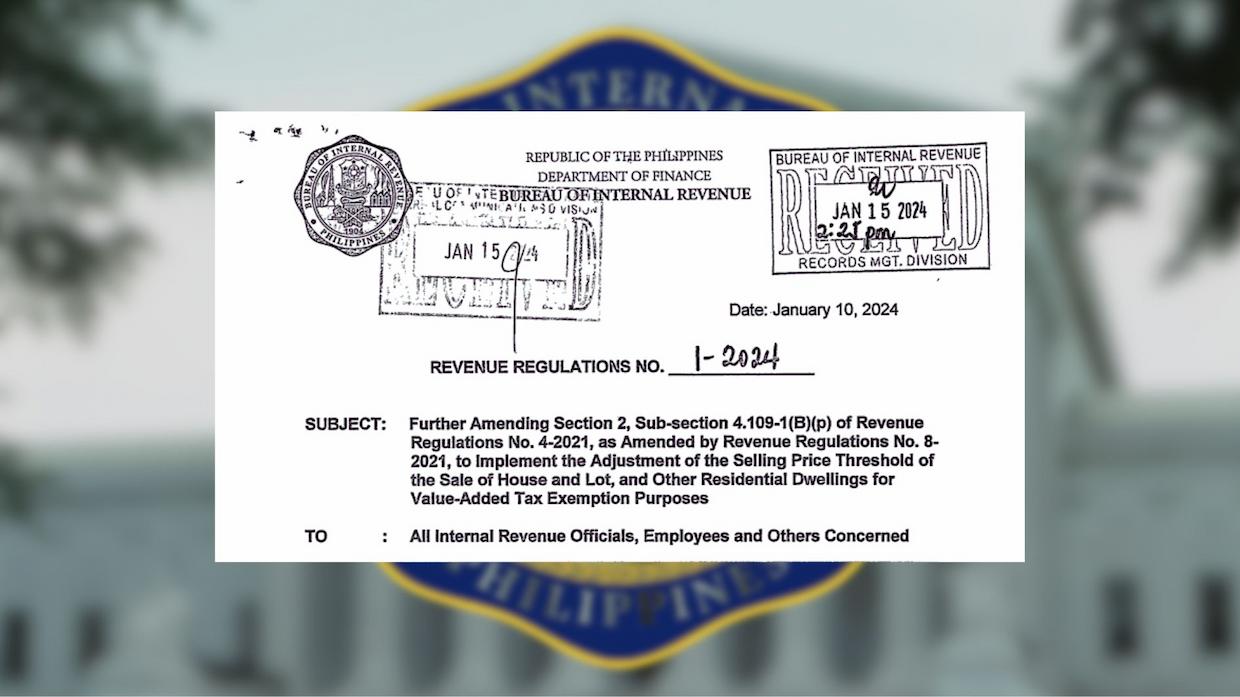
Real estate VAT exemptions often depend on price thresholds and the exact classification of the property and transaction. Regulatory updates around 2024 adjusted certain residential dwelling thresholds for VAT exemption, which means outdated pricing assumptions can lead to major exposures.
- Misclassification between socialized, low-cost, and other residential categories can change tax outcomes.
- The BIR commonly asks for contracts to sell, deeds, pricing schedules, and proof of actual consideration.
- Developers and sellers frequently face audits for mixed-use projects where residential and commercial components overlap.
Action: For each unit sale, prepare a short “VAT eligibility sheet” showing the unit type, contract price, and the legal threshold basis you’re relying on.
Many VAT exemptions apply by operation of law, but the practical reality is that companies often need to prove eligibility through registration status, accreditation, or documentary support—and sometimes seek BIR confirmation or ruling for higher-risk categories.
- The BIR provides checklists for rulings related to VAT-exempt transactions, which can guide your documentation build-out.
- For status-based exemptions (e.g., cooperatives or accredited institutions), the supporting government registrations matter.
- For incentive-related VAT exemption on importation, relevant agency certifications may be required depending on the applicable incentives’ framework.
Action: Treat “exemption eligibility” as a compliance file: keep certificates, accreditation proof, and a short legal memo tied to your revenue lines.
If the BIR disallows an asserted VAT exemption, the company may face deficiency VAT, penalties, and interest, and may also lose the tax benefit strategies that depended on that classification.
- Reclassification can retroactively affect multiple quarters.
- Input VAT allocation may be challenged if exempt and taxable streams were not properly separated.
- A weak exemption position often triggers broader audits beyond VAT.
Action: Conduct a quarterly internal review of exemption-reliant transactions before the BIR does it for you.
A VAT exemption dispute typically requires you to show the legal basis, prove the facts that place you within that category, and reconcile your documents to your returns and books.
- Identify the exact Section 109 paragraph you are invoking.
- Gather status/threshold documents (e.g., accreditation, registration, sales summaries).
- Match each invoice to a supporting contract or proof of qualifying activity.
- Prepare a reconciliation table linking exempt sales to VAT returns and financial statements.
Action: Build an “audit-ready binder” per quarter with a table of contents, not just a folder of scattered PDFs.
The BIR commonly focuses on documents that prove nature of transaction, eligibility, and correct invoicing aligned with current rules.
- Contracts and service descriptions that clearly match the statutory exemption.
- Accreditation or registration proofs for entities claiming status-based exemptions.
- Sales schedules supporting threshold-based exemption computations.
Action: Require a short internal “VAT exemption annotation” on every high-value exempt invoice explaining the legal basis in one sentence.
Litigation risk rises when the exemption is fact-sensitive and the taxpayer cannot show consistent, complete documentation across contracts, invoices, and books.
- Using old thresholds or outdated exemption rules.
- “Generic” invoice descriptions that do not reflect the qualifying nature of the transaction.
- Failure to separate exempt, zero-rated, and taxable sales in accounting systems.
- Reliance on BIR issuances that are later challenged as inconsistent with the Tax Code.
Action: Update your invoice templates and chart of accounts to force proper VAT category tagging at the time of transaction.
Several landmark decisions show how strictly the Court can interpret the relationship between the Tax Code and BIR issuances, and how documentary context can determine outcomes.
- BIR v. First E-Bank Tower Condominium Corp. (G.R. Nos. 215801 & 218924, January 15, 2020): The Supreme Court invalidated the BIR circular that tried to impose taxes on condominium association dues, affirming that these collections are not subject to VAT under the specific legal framework.
- Aces Philippines Cellular Satellite Corp. v. CIR (G.R. No. 226680, August 30, 2022) and RMC 5-2024: The decision and subsequent BIR clarification show how cross-border service tax treatment—including VAT aspects—can pivot on legal characterization and the nature of the payment.
Action: When your exemption position depends on a BIR circular, check whether Supreme Court jurisprudence supports the circular’s interpretation of the statute.
You should consider tax counsel when the exemption is high value, threshold-sensitive, or likely to be challenged based on evolving regulations and jurisprudence.
- Large real estate portfolios with mixed unit types and price points.
- Enterprises claiming status-based exemptions with complex operational structures.
- Cases where the BIR’s position appears to rely on a rule that may exceed the statute.
Action: Request an issue-spotting review of your VAT exemption file before you receive a formal Letter of Authority.