VAT Assessments in the Philippines: A Practical Survival Guide for Business Owners
VAT Assessments in the Philippines: A Practical Survival Guide for Business Owners

A VAT assessment often arrives at the worst time: cash is tight, deadlines are stacked, and you suddenly receive a letter that looks technical and intimidating.
The good news is that many VAT assessments are manageable if you respond calmly, on time, and with the right documents.
In practice, VAT findings usually come from mismatches: your declared sales do not align with third-party data, your input VAT documents are incomplete, or your invoicing is not compliant with the latest rules.
These are fixable issues—but only if you act early.
Think of the first week after receiving a BIR notice as your “damage-control window.”
Your goal is to confirm the authority of the audit, preserve your records, and organize your invoices and schedules before you draft any formal reply.
- Don’t assume the assessment is final just because the numbers look firm.
- Don’t ignore early notices; they set up the later formal steps.
- Don’t reply emotionally or casually—every written response becomes part of the official record.
Action: Create a folder today for your VAT returns, sales and purchase summaries, and invoices per quarter, then assign one person to track deadlines.

Send us an email with the details for
personalized recommendations or schedule a consulation if needed.
A VAT assessment is the BIR’s formal claim that a VAT-registered taxpayer underpaid VAT and must pay deficiency VAT plus penalties, based on an audit of records and returns under the VAT provisions of the NIRC and implementing rules. The assessment must state the facts and the law supporting the BIR’s computation to be valid.
- It can involve output VAT, disallowed input VAT, or both.
- It may cover one quarter, several quarters, or multiple years.
- It often starts with an audit authorized by a Letter of Authority (LOA), not just a general notice.
Action: Check the taxable periods listed in your LOA and compare them to the periods mentioned in later notices to spot scope issues early.
The legal foundation is Title IV of the NIRC, as amended, plus the rules on assessment due process under Section 228 of the Tax Code and Revenue Regulations, including amendments that require proper notice, sufficient factual and legal bases, and strict observance of timelines.
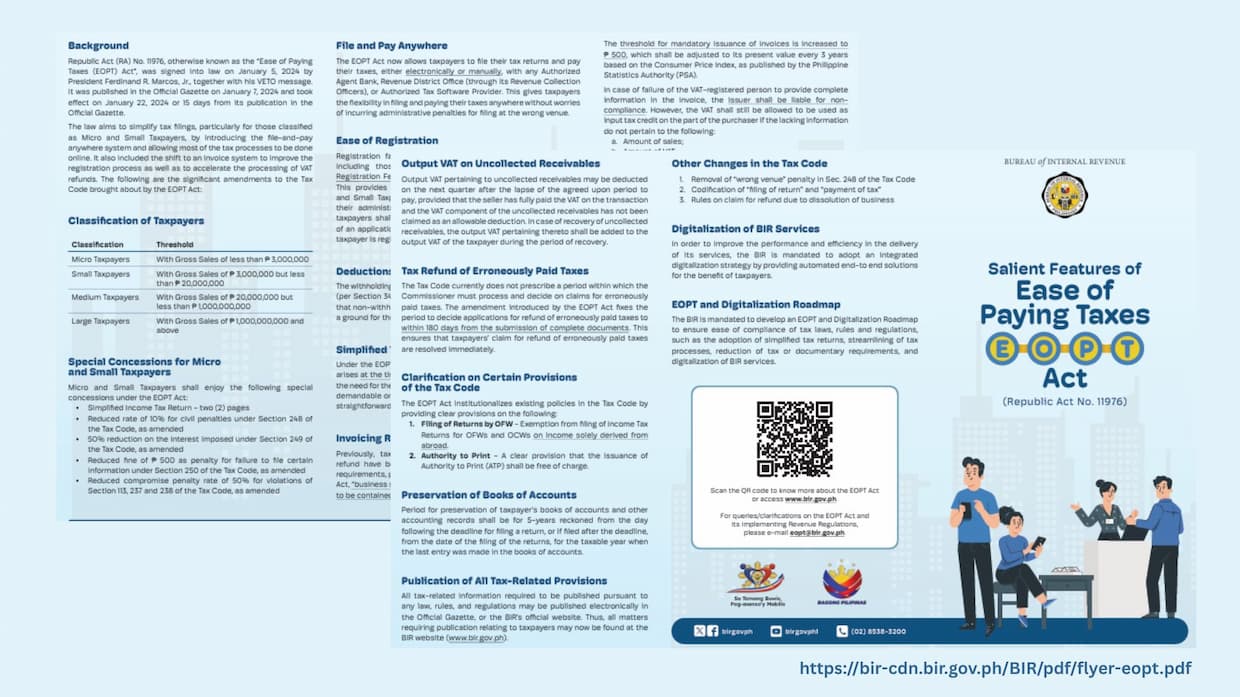
A major recent development is the Ease of Paying Taxes (EOPT) law and its VAT regulations, which harmonize VAT documentation and move key concepts for services toward an accrual/billing framework, with “invoice” as the principal document for both goods and services.
- Under RR 18-2013 (amending RR 12-99), a PAN must show in detail the facts and law for the proposed assessment.
- Taxpayers generally have 15 days to respond to a PAN.
- A taxpayer may protest the FLD/FAN within 30 days of receipt.
- For reinvestigation, supporting documents must generally be submitted within 60 days from filing the protest.
- The BIR’s ordinary assessment period is generally three years, with exceptions; the Supreme Court has recently emphasized limits on the use of the extraordinary 10-year period.
Need help interpreting your deadlines and legal options?
Email admin@lawyerphilippines.org.
Action: Before writing any response, confirm (1) your receipt date, (2) your deadline count, and (3) whether your protest is for reconsideration or reinvestigation.
Ignoring a VAT assessment can lead to finality of the assessment, collection actions, and avoidable penalties, even when you have strong defenses.
The rules also allow parts of an assessment to become final if you only dispute some issues without explaining why the others are wrong.
The EOPT Act also introduced concessions for micro and small taxpayers, including reduced civil penalties and reduced interest, which can matter in settlement or compromise discussions.
- You may face surcharge and interest on top of deficiency VAT.
- Some defects can be fixed early (documentation, reconciliation).
- A late or defective protest can forfeit otherwise valid defenses.
Action: If cash flow is a concern, ask your accountant to prepare a worst-case number early so you can plan whether to contest, negotiate, or explore compromise.
While each audit varies, VAT assessments commonly move from audit authority to preliminary findings, then to formal notices and protest deadlines as structured under the due process rules.
- Start: An LOA authorizes named revenue officers and defines the audit scope. Absence of a valid LOA can void assessments, as emphasized in jurisprudence.
- Middle: The BIR reviews books, invoices, and returns and may issue a PAN if it finds a basis for deficiency.
- Formal demand: An FLD/FAN follows, which you must protest within 30 days.
- Decision stage: The BIR must act within prescribed periods; inaction can open CTA remedies under the rules.
Action: Request and keep copies of the LOA, the audit working papers given to you, and all proof of your submissions and receipts.
Recent legal and administrative updates change what “good evidence” looks like for VAT, especially for invoicing and recognition of sales.
Separately, the law now explicitly covers VAT on digital services, including rules on liability of resident and nonresident digital service providers and a reverse charge mechanism for certain purchases by VAT-registered taxpayers.
- “Invoice” is now the key VAT document for both goods and services under EOPT-aligned rules.
- The PHP 3,000,000 VAT threshold is subject to periodic CPI-based updating every three years under the EOPT framework.
- Digital services VAT rules may matter if you sell subscriptions, online ads, software access, or marketplace services to Philippine consumers.
Action: Ask your accounting team to verify that your invoice format, series, and required information are aligned with current EOPT and VAT rules before your next quarter closes.
The strongest VAT defenses typically rely on clean, reconcilable documentation that ties your VAT returns to your books and to compliant invoices.
The EOPT framework also clarifies that missing minor invoice details may not automatically defeat input tax claims if core information is present.
- Quarterly VAT returns and attachments.
- Sales and purchase journals and summaries per quarter.
- VAT invoices that show the required core details.
- Proof of payment where relevant to the claim being tested.
- Importation documents for input VAT on imports.
Action: Prepare a quarter-by-quarter reconciliation sheet matching (1) your VAT return, (2) your general ledger, and (3) your invoice list.
Many deficiency VAT findings trace back to input VAT disallowances, invoice defects, or mismatches between declared sales and third-party data.
The EOPT Act’s invoicing reforms reduce some technical traps but still require accurate core details.
- Missing or incorrect name/TIN, amount of sales, amount of VAT, description, or date can still be critical.
- Errors in invoice series or unsupported “summary schedules” can invite disallowance.
- Inconsistent treatment of zero-rated, exempt, and taxable sales can inflate output VAT.
Action: If you discover invoice defects, document corrective steps (supplier confirmations, corrected invoices where allowed, internal memos) and present them with a clear narrative in your PAN response.
Philippine jurisprudence repeatedly emphasizes that VAT assessments must respect audit authority limits and due process requirements.
- Medicard (G.R. No. 222743, 2017): The Supreme Court highlighted the importance of a valid LOA; assessments issued without proper authority can be void.
- Sony Philippines (G.R. No. 178697, 2010): The Court disallowed a deficiency VAT assessment that went beyond the scope of the LOA, underscoring that audit authority is not open-ended.
- Villanueva (G.R. No. 249540, 2024): The Court reinforced strict rules on notice and service of assessment documents under Section 228 and RR 12-99, reminding taxpayers to challenge defective service and unsupported assessments.
- Recent Supreme Court guidance on prescription: The Court has emphasized constraints on invoking the 10-year assessment period and the need for proper disclosure when the BIR claims extraordinary prescription, with implications for VAT cases.
Action: If your case involves LOA scope issues, missing factual/legal bases, or questionable service, raise these early and clearly in your written protest.
A smart response is one that preserves your rights while buying time to assemble the best evidence, especially if you are still verifying your numbers.
- Acknowledge receipt and request reasonable time where allowed.
- Answer only what you can support with documents.
- Avoid signing statements that concede liability prematurely.
- Maintain a single “official narrative” across all submissions.
Action: Draft your response outline first (issues, facts, documents, legal bases) before writing the final letter to avoid inconsistent statements.
You should strongly consider counsel when the amount is material, when the BIR’s notice appears defective, or when your input VAT is at risk due to supplier or documentation issues.
- Large or multi-year audits.
- Issues involving zero-rated sales, importations, or complex supply chains.
- Potential fraud allegations or 10-year prescription assertions.
Action: Bring your LOA, PAN/FAN, VAT returns, and a quarter-by-quarter reconciliation to your first consult to maximize the value of legal review