2025 Guide for the Termination of Regularized Employees for the Philippine HR
2025 Guide for the Termination of Regularized Employees for the Philippine HR

The 2025 Guide to the Termination of Regularized Employees covers what an HR Officer needs to know about the process for terminating Regularized Employees in the Philippines, including Just Cause and Authorized Cause, the Administrative Hearing Process for both, and useful reminders about the Notice to Explain.

It is important to know & follow the correct Process when considering the termination of a Regularized Employee.
If you are a HR practitioner in the Philippines your role is to balance both the needs of the company and those of its employees.
And you are already aware that the laws that grant termination of regularized employees for certain causes are the same laws that protect an employee’s security of tenure.
Below I’ve provided an overview of Employee Termination in the Philippines and added links with actual Termination stories and cases. I also cover the Administrative Hearing Process to help a busy HR Practitioner comply with Philippine Labor law.
If you have any specific questions regarding the Termination of Regularized Employees please contact me.

Send us an email with the details for
personalized recommendations or schedule a consulation if needed.
Termination of Employment has strict requirements under Philippine Labor Law.
If you are considering the Termination of a Regularized employee, then you will need to determine which legal cause applies. You will also need to follow the Admin Hearing Process. Both are guided by Philippine Labor Law.

Do you have a problem employee?
Not following Philippine Labor Law is costly!
Separation Pay or fines can be levied against the company by DOLE (Department of Labor and Employment).
An employer uses 2 types of legal causes when considering Termination of Employment:
- Just Causes – primarily causes where the employee is at fault.
- Authorized Causes – when there are business contingencies that force termination.
An employee’s health situation may also be a reason for Termination.
Let’s first talk about Just Causes.
Termination can take place under Just Cause when the employee is at fault.
Just Causes are listed in Article 282 of the Labor Code and reproduced below:
• Serious Misconduct or willful disobedience by the employee of the lawful orders of his employer or representative in connection with his work
• Gross and Habitual Neglect by the employee of his duties
• Fraud or Willful Breach by the employee of the trust reposed in him by his employer or duly authorized representative
• Commission of a crime or offense by the employee against the person of his employer or any immediate member of his family or his duly authorized representatives and
• Other causes analogous to the foregoing

There are several legal grounds that can be used for the Termination of Regularized Employees.
You and I may have our own notions about which specific situations correspond to the above.
However, these are technical terms around which the Supreme Court has built Jurisprudence that defines each and provides guidance as to what conditions must be present for any one to be invoked.
For instance, Loss of Confidence can only be applied to two types of employees that have an employer’s trust and confidence:
• An employee with Managerial functions; OR
• An employee who manages and safeguards his employer’s money or property
It also stresses that Loss of Confidence only applies to acts which are deliberate, work-related, and backed up by substantial evidence.
There’s an entire body of doctrine which examines what constitutes fraud in labor, this in addition to the doctrine defining the Admin Hearing Process that must be followed to determine whether such fraud exists or not in the case of a particular employee.

You need to know Labor Law to properly do your job as an HR Officer.
What this means to you as an HR Practitioner is that to effectively Terminate an employee, you need to understand what each of the Grounds means legally and what process you need to follow to comply with the legal process in order to best serve your company.
Considering the repercussions if a Labor Arbiter determines that the employee’s dismissal was against the law, the stakes can be just as high for the company as they are for the employee.
This necessitates the close study of the Grounds and Admin Hearing Process on the part of HR, as well as coordination with legal counsel.
What is an NTE?
The NTE is often a major area of concern for both employees and employers, so I will go through it in more detail here.
The Notice to Explain is a formal document issued to an employee, typically by their immediate supervisor or the Human Resources department, when the employee is accused of misconduct.
This notice is commonly provided after an investigation into an incident, but it can also be issued during an ongoing investigation to highlight significant issues or findings that may indicate a serious violation.
The Notice to Explain serves its purpose by allowing the employee the chance to clarify their actions, providing insight into the circumstances surrounding the incident or their decision-making process.
The document consists of three key components: a request from the employer for the employee to provide an explanation, background information along with a detailed and descriptive account for the employee to respond to, and specific facts or incidents that require clarification from the employee
An NTE has legal importance.
Issuing an NTE is not just a procedural formality; it is a legal requirement that protects both the employer’s and employee’s rights. Failure to issue an NTE can lead to legal repercussions such as claims of unlawful dismissal. Employers must ensure that they follow due process meticulously, as courts often scrutinize these procedures during disputes.
Best Practices for Drafting an NTE
Clarity and Detail: The notice should clearly articulate the reasons for its issuance, citing specific incidents and applicable company policies.
Comprehensive Documentation: Maintain meticulous records of all communications concerning the NTE, including methods of delivery and any employee feedback. –
Prompt Delivery: The NTE should be delivered swiftly upon identifying grounds for potential termination, underscoring the employer’s commitment to due process.
Illustrative Scenario: Imagine a situation where an employee is accused of habitual tardiness. The employer issues an NTE that outlines particular instances of tardiness while referencing the company’s attendance policy. The employee is then given the opportunity to present mitigating factors, which are reviewed during an administrative hearing prior to any termination decisions being finalized.
What is the Distinction of the NTE from Other Notices?
An NTE specifically addresses the potential grounds for termination, whereas a Show Cause Memo may be issued in less severe instances where disciplinary action is being contemplated but has not yet been concluded.
Recognizing these differences enables HR professionals to select the most appropriate response.
Below is a Sample Template for Notice to Explain
[Company Letterhead]
[Date]
[Employee Name]
[Employee Address]
Subject: Notice to Explain (NTE)
Dear [Employee Name],
This letter serves as a Notice to Explain regarding [specific incident(s) leading to potential termination].
Details:
– Date(s) of Incident(s): [list dates]
– Description of Incident(s): [provide details]
– Relevant Company Policy: [cite specific policy]
You are required to submit your written explanation within five (5) days from receipt of this notice.
Sincerely,
[Your Name]
[Your Position]
When it comes to terminating an employee using Just Causes the HR Practitioner must follow a specific set of steps and a particular Administrative Hearing Process.
You will need the following:
- Notice to Explain (NTE Meaning)
- An Admin Hearing where the employee has an opportunity to air his side
- Issuance of a Notice of Termination
Let’s take each one in turn.
Notice to Explain
What is a Notice to Explain and how is it used in Termination for Just Cause?
The term Notice To Explain is often shortened to NTE by HR personnel but employees may not know what it means and ask for the NTE meaning. It may also be called a Show Cause Memo or Show Cause Order. It is the start of the Admin Hearing Process under Just Cause.

A Notice to Explain is the first step when terminating an employee due to Just Causes.
A Notice to Explain is a written notice to the employee. It should have the following:
- Details of the Cause for Termination based on Art 282
- A List of the facts and instances that might lead to Termination
- Cites the particular company item in the company’s Code of Discipline
- A request for a written explanation within 5 days [King of Kings Transport vs. Tinga and Velasco, G.R. 166208]
The Notice To Explain should also:-
- Be served at the employees last known address
- Delivered to the employee in person. If it cannot be delivered in person then you should send it by registered mail to the employees last known address.
When sending an NTE a signed receipt is also good practice. You could be required to present evidence that you correctly followed the Just Cause Admin Hearing Process later on.
In our modern world we also use Text, Emails and Work Platforms to deliver messages direct to employees. It can be considered good practice to either send the Notice To Explain to the employee through these mediums as well, OR advise them that an important letter has been sent to their home address through these channels.
It is important to note that it will be harder to evidence in court that you have followed the correct process if you use any of these mediums as the primary way of delivering the Notice To Explain, rather than a physical letter delivered to their home with a Receipt Request.
Administrative Hearing
What is the Administrative Hearing Process in Termination for Just Cause?
The Admin Hearing Process is the main opportunity an employee has to air his side.
An an HR Practitioner it is important that you follow the Administrative Hearing Process correctly.
During the Hearing the employee can present facts in his defense to counter the employer’s charge. The employee can also bring along counsel.

An employee has the opportunity to explain his side during an Administrative Hearing.
What if an employee does not show up to this Hearing?
Some employees try to avoid this step in an effort to avoid the Admin Hearing Process and later claim that the company did not follow due process.
However, the law recognizes that this isn’t the employer’s fault, especially if you can prove that a letter about the Hearing was sent to the employee. (This is why it is important to request a Signed Receipt of the letter).
By providing an opportunity to be heard, you have complied with the law.
It is up to the employee to now appear.
It is also good practice to have and keep an attendance sheet for all participants attending the Administrative Hearing Process meeting.
Notice of Termination
You will have to issue a Notice of Termination if it is found that the employee should be terminated under Just Cause after the Administrative Hearing Process.
The Notice of Termination is a written letter that is ideally given to the employee in person. If that isn’t possible, then sending it through registered mail to his last known address can suffice.

A notice of Termination may result after Management has decided on the employee’s case.
You will need to state:
- All circumstances involving the charge against the employee have been considered; and grounds have been established to justify the severance of their employment.
- The Ground/s in the Notice of Termination should, of course, be the same as that which was listed in the NTE (Notice to Explain).
By complying with the Administrative Hearing Process and correctly identifying the Grounds needed for Termination, you will be following Philippine Labor Law and complying with Termination Philippines law.
Sometimes, business pressures force down-sizing or the letting go of employees and Philippine Labor Law does recognize this in Article 283.
Termination Philippines: Authorized Causes
- The installation of labor-saving devices
- Redundancy
- Retrenchment to prevent losses or
- The closing or cessation of operation
By now, you know enough to wonder how this has actually played out in jurisprudence.
You’d be right to wonder.
Cases have given us a common understanding of these terms and the correct criteria to apply before invoking them.

Under Authorized Causes an employer can terminate employees when business is bad.
For instance, the Court has specified that the following must exist for Retrenchment to be used:
that the losses expected are substantial and not merely de minimis in extent; that the expected losses are reasonably imminent such as can be perceived objectively and in good faith by the employer; that the retrenchment is reasonably necessary and likely to effectively prevent the expected losses; and that the imminent losses sought to be forestalled are substantiated. [G.R. 121314, Feb 12, 1998]
In the above quoted case, the employer’s Authorized Cause for Termination was upheld by the Supreme Court.
The employer Edge Apparel showed evidence of its difficult financial position due to a loan and reported a loss from 1989 to 1992. It also rebutted claims made that cutting the entertainment expenses would have enabled it to keep the 27 employees.
As HR Personnel is it important to understand that a company or employer can not simply claim Retrenchment. They have to substantiate Authorized Causes for Termination as indicated above.
You need to follow a few guidelines if you are using an Authorized Cause for Termination:
- Written Notice to the employees 1 month before
- Notice to the DOLE (Department of Labor and Employment) 1 month before Termination date using the DOLE forms
Here is what the DOLE form for Retrenchment/Closure RKS Form 5 2010 looks like:
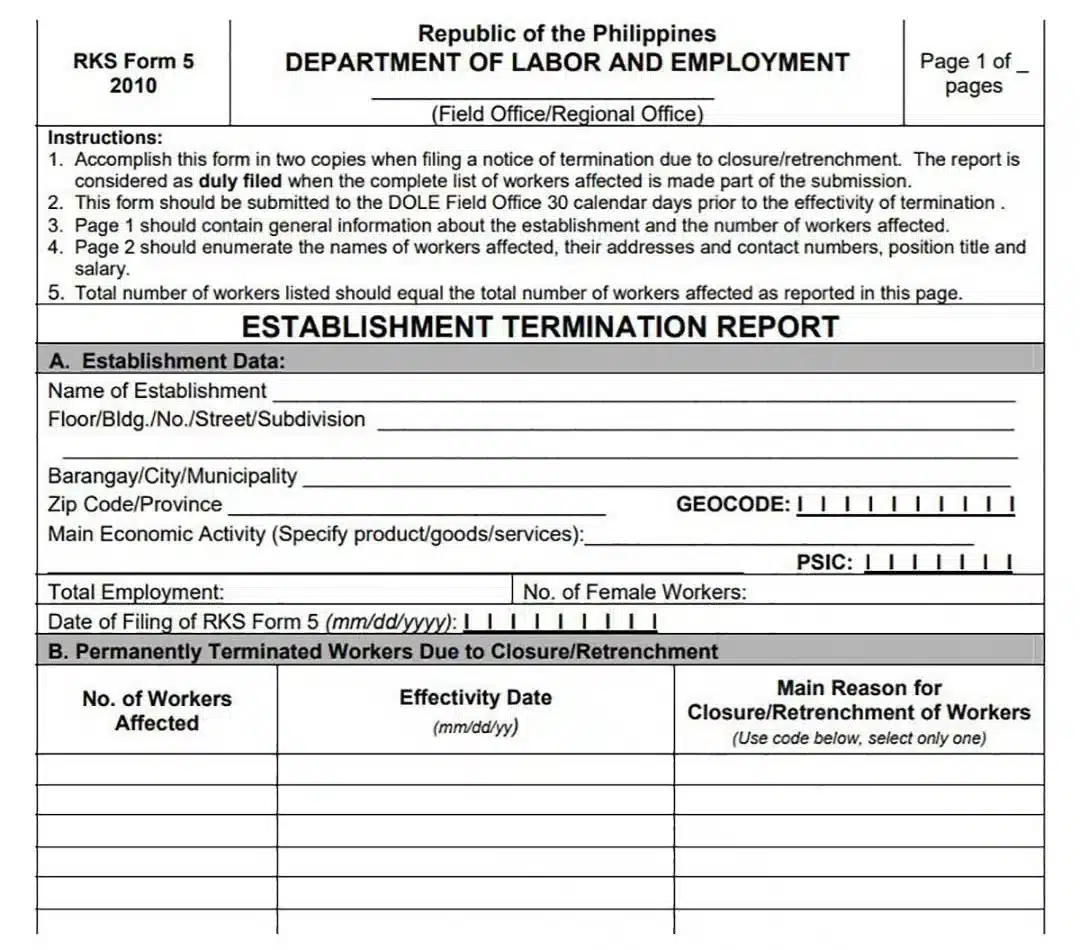
DOLE RKS Form 5 2010 for closure
Termination under Authorized Cause is a simpler process than Termination for Just Cause.
Still, it is important to follow the Process and file the forms correctly to ensure compliance with Philippine Labor Law.
By doing this, you are serving the company’s interests and ensuring that the business is protected in court.

Separation Pay may still be required.
You will need to pay your employee Separation Pay, with the amount depending on what Ground was used:
- At least 1 month of pay or 1 month per year of service, whichever is higher where the Authorized Cause falls under installation of labor-saving devices or Redundancy.
- At last 1 month pay or at least ½ month pay for every year of service for Retrenchment or the Closing of Operations not due to serious business losses or financial reverses.
Note that a fraction of a year of at least 6 months is considered one year.
An employer can Terminate an Employee due to illness under Article 284.
However, an employer can’t Terminate someone simply because she or he has a fever.
You can Terminate an employee if there is a serious health issue.
In fact the Court, laid down substantive Requirements for Termination due to Illness cases:
- Certification by a competent Public Health Authority
- Serious or contagious disease that cannot be cured within 6 months
Recently, the Supreme Court has decided that Termination due to health reasons needs to follow the two notice process. [G.R. No. 202996]
This is the same process described in the earlier section about Just Causes. There must be:
- An NTE (Notice to Explain)
- An Administrative Hearing
- A Notice of Termination.

An employer can terminate people for other reasons.
You can sever the employee-employer relationship in other instances too. Some of these are:
- When the project ends and the employees were project-based
- When the employee was hired for seasonal labor
- When the employee was a casual laborer
You can terminate when the employment is of these types as these are all understood and legally recognized.
However, don’t become complacent. Keep your papers in order and ensure you are following the correct Termination process.
Terminating Regularized Employees in the Philippines requires that the Admin Hearing Process and the Grounds for valid Termination comply with Philippine Labor Law.
Both are equally important if you want to protect your employer and fully do your job as an HR Officer.

To fully do your job as an HR Officer, you have to have a deep understanding of the Process and Grounds for valid Termination
I have dealt with many HR Personnel but want to draw your attention to one of the best that I knew and why they were the best.
This HR Officer kept absolutely impeccable documentation. She ably transacted with government agencies and knew the Philippine Labor Code extremely well.
To be a good HR Officer you have got to know the law, be able to explain the law clearly to your employer, follow due process and record and file everything correctly and neatly.
Atty. Francesco C. Britanico, FCB Law Firm, Lawyers in the Philippines
See also Termination due to AWOL, Tardiness or Abandonment