Philippine Judicial and Administrative Naturalization (Everything you need to know about becoming a Philippine Citizen)
Philippine Judicial and Administrative Naturalization (Everything you need to know about becoming a Philippine Citizen)
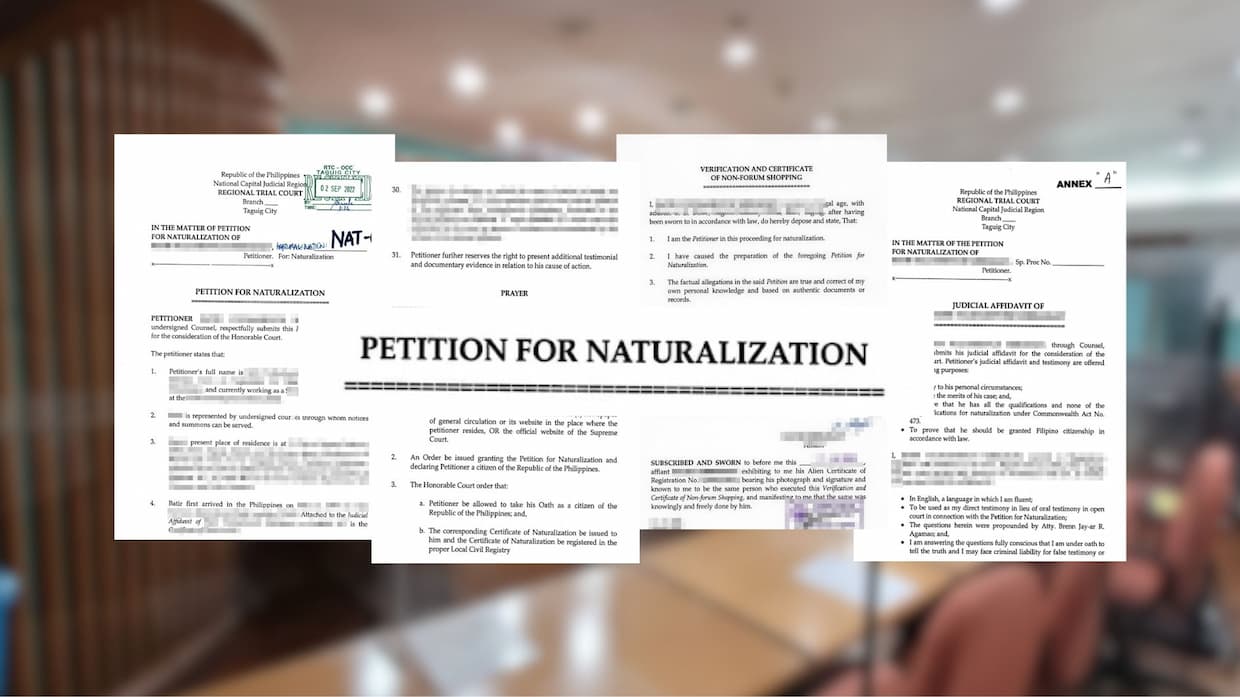

Administrative Naturalization and Judicial Naturalization are the two routes to consider if you are thinking about applying for Philippine Citizenship. You should read this post carefully as it provides information about both.
Under certain circumstances, you can Petition for Philippine Citizenship yourself.
However, your particular circumstances might require a court process. This will mean hiring a lawyer and presenting evidence to the court.
In this post I outline the Process for Naturalization in the Philippines, the fees and timelines and provide practical advice for how to proceed. If you have any specific questions or concerns you can Contact Me

Send us an email with the details for
personalized recommendations or schedule a consulation if needed.

Obtaining Philippine Citizenship confers several benefits.
There are compelling reasons for you to Petition to become a Filipino Citizen.
Foreigners often opt to become Philippine Citizens due to the restrictions on foreign ownership of land and business and the practice of a profession.
If you have Citizenship you can buy as much land in the Philippines as you want.
In addition, you no longer have to abide by the 40% foreign ownership cap for most businesses.
And you can practice any profession (some professions are now limited to Filipinos) AND you can participate actively in elections.
Filipino Citizenship is also useful for travel. South East Asia is completely open to you as there are reciprocal travel arrangements in place with several countries.
Given these compelling reasons, foreigners who opt to stay in the Philippines for the long haul often decide to apply for Philippine Naturalization to better pursue their business interests.
If you have decided that the Philippines is the right place for you, then Philippine Citizenship might just be the right decision.

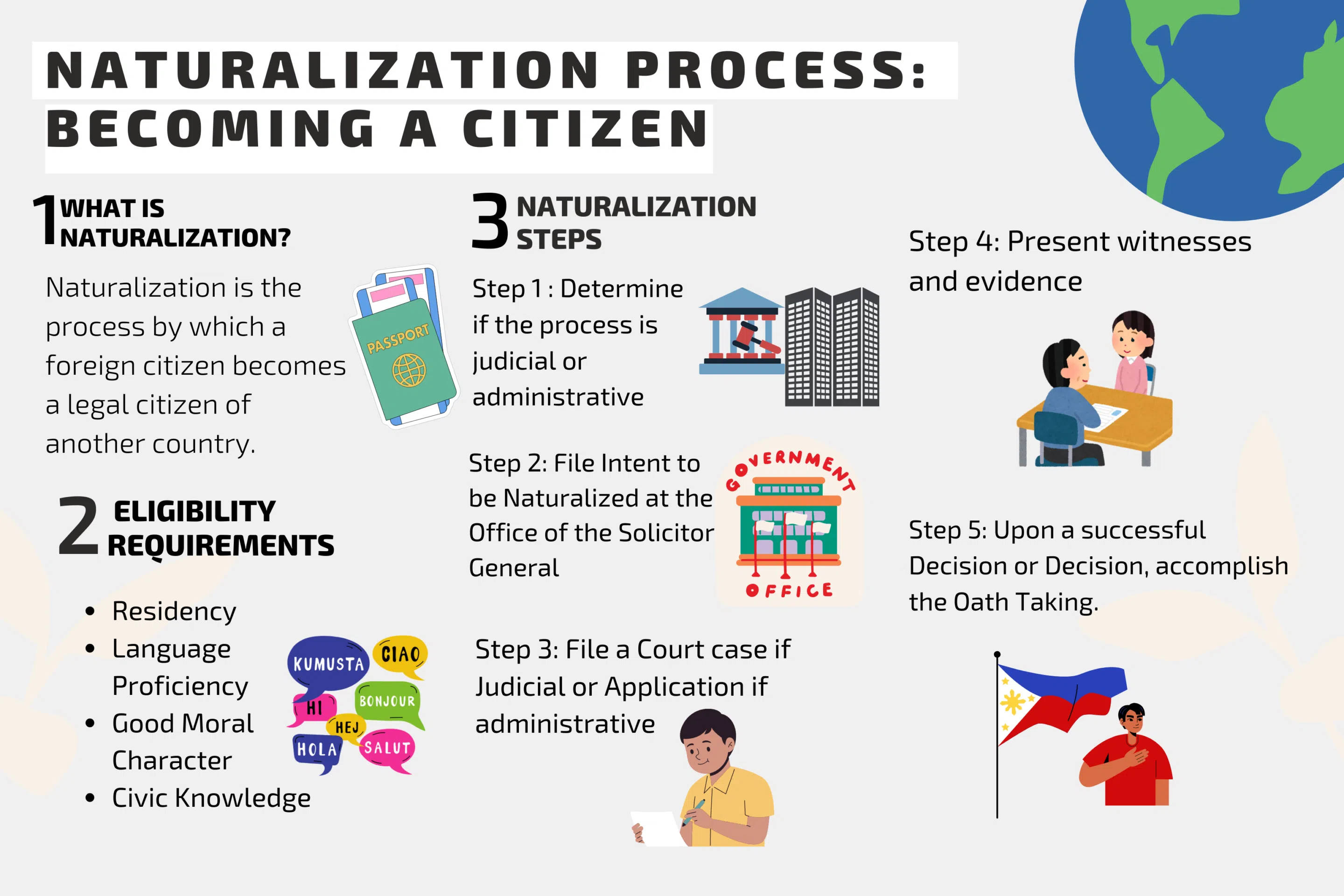
You can use the Administrative or Judicial Naturalization processes to obtain Philippine Citizenship.
There are 3 ways for foreigners to get Philippine Citizenship. This article focuses on 2 of those processes.
The third route is Legislative Naturalization but this requires an act of Congress. Unless you know Congress (!) and have done something incredibly spectacular, it is far more likely that you will go through one of the below processes.
1. Administrative Naturalization
Administrative Naturalization is open to those who were born in the Philippines and who have resided here since birth. If this describes your situation, then it is pretty likely you can Petition for Naturalization using this option.
There are other requirements you will have to comply with but those are far easier to manage.
See our Administrative Section to check if you fit the bill.
2. Judicial Naturalization
If you don’t qualify for Administrative Naturalization, then you will have to Petition for Judicial Naturalization. It is actually a fairly easy, although detailed process. (If you meet all the requirements.)
While one of the stumbling blocks is the 10 year Residency Requirement, this can actually be cut to 5 years under certain conditions.
Be sure to check all the boxes and have competent counsel, however, since Naturalization Petitions are thrown out if they do not strictly adhere to the rules.
Check out our Judicial Naturalization Process for more information.
It is important to note that neither of these processes apply to former Filipinos.
There is a completely separate process to Reinstate Philippine Citizenship for former Filipinos but it is not covered in this article.
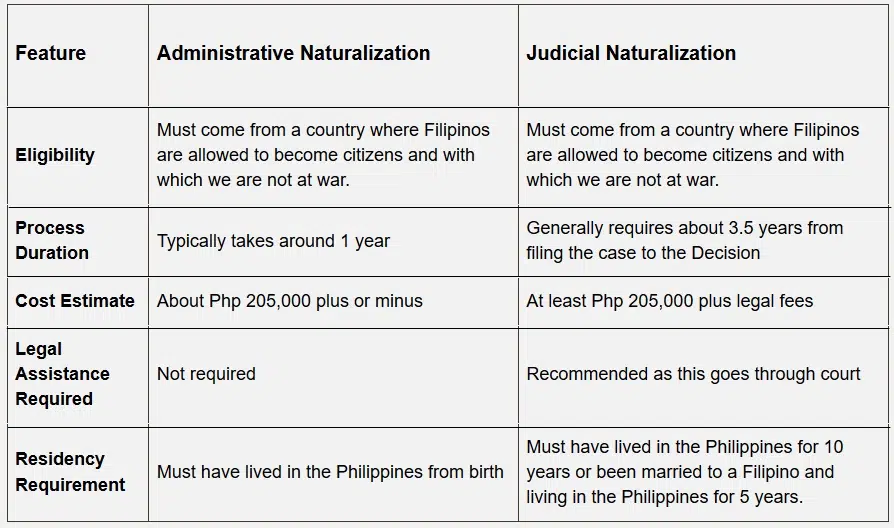
Quick Comparison of Judicial vs. Administrative Naturalization
You can be denied Philippine Citizenship on several grounds.
Any group who accepts new members wants productive and nice applicants, and the Philippine Government is no different.
Some sure-fire ways for being disqualified from becoming a Philippine citizen would be if you were a trouble maker, if you didn’t mingle with Filipinos, or belonged to a country with whom the Philippine Government doesn’t see eye to eye.
So for instance, you would be refused if you opposed the Philippine Government, belonged to groups that opposed the Philippine Government or groups that believe in violence to get the outcome you desire.
Also, you best not apply if you practice or believe in polygamy, were convicted of a crime of moral turpitude, suffer from mental alienation or suffer from an incurable contagious diseases.
Lastly, if your country doesn’t allow Filipinos living there to become citizens or it is at war with the Philippines you should probably save yourself the time and expense of Petitioning for Naturalization in the Philippines.
A Philippine-born foreigner can likely consider Petitioning for Administrative Naturalization.
If you aren’t disqualified by any of the above and you were born and have lived in the Philippines your entire life, you can DIY your Philippine Naturalization.
Administrative Naturalization usually takes 1 year and costs about Php 170,000-205,000 or about USD 4,000. This cost is broken down into:
- 1,000 Form Fee
- 39,000 Filing and Docketing Fee
- 100,000 Oath Taking and Naturalization Fee
- 30,000 to 65,000 Publication Fee
The Process for Naturalization through Administrative Order is simple enough to handle by yourself although it can be time-consuming.
It is a 2 step process of writing your Petition for Naturalization and then Filing it.
Remember to read the fine print carefully and pay attention to detail.
That way, errors can be avoided and your Petition can be quickly processed and granted.
Do you qualify for Administrative Naturalization?
To qualify you have got to have all of the below. Otherwise, it is best if you file for Judicial Naturalization.
- You were born and have lived in the Philippines your entire life;
- You are 18 years old at the time of the Petition;
- You are of good moral character, believe in the principles of the Constitution and conduct yourself well with the Government and your community;
- You were in a CHED (Commission on Higher Education) recognized school for primary and secondary education where Philippine history, civics and education was taught and where enrollment is for all races. This also applies to your minor children;
- You must have enough income to support yourself and your family except if you cannot practice your profession due to Citizenship requirements;
- You speak any Filipino dialect;
- You mingled with Filipinos.
Step 1: Create your Petition

Create your Petition first!
Break out your pencils, because you will have to write quite a bit.
Thankfully the information you need is pretty simple and is listed below.
In addition, do not forget the attachments you need as these are important requirements and that you will need to have 5 copies.
Please include the following in your Petition:
- A thumbmark on every page;
- A passport-sized photo attached to each copy;
- Your full name, nickname and any other name you are known by;
- Your place and date of birth;
- Your current and former addresses;
- Your adoptive or natural parents name, citizenship, and residences;
- Your trade or profession and that of your wife and children;
- Your civil status and the date and place of all marriages as well as the name, date of birth, birthplace, citizenship, and residence of the spouse. If you were Legally Separated or Annulled, you will have to include the date and the court that granted the Decree. If you have been widowed, you will need to provide the date and place of death of your Spouse.
- Declaration that you shall not be a Public Charge (in other words, dependent on the government).
- Declaration that you really desire to become a Philippine Citizen and renounce allegiance to any other country or state.
You will also need to attach the following documents:
- Your original or Certified Copy of your Birth Certificate
- Your original or Certified Copy of your Alien Certificate of Registration and Native-born Certificate of Residence;
- Your original or Certified Copy of your Marriage Certificate, Death Certificate if widowed, or Legal Separation Decree if separated;
- An original or Certified Copy of your child/children’s Birth Certificate, Certificate of Registration, or Native-born Certificate of Residence;
- Affidavit of Financial Capacity supported by documents such as bank, stock or ownership of other properties;
- Affidavits of 2 Filipinos of good standing who live in your city and who have known you for at least 10 years. These two witnesses must assure the Special Committee on Naturalization that you are of good moral character and that you are qualified to become a Philippine Citizen;
- A Medical Certificate stating that you have no drug dependencies, are not mentally alienated, do not have AIDs or any contagious, incurable disease;
- School Records and a Certificate stating that your children are enrolled in DECS (Department of Education, Culture and Sports) Accredited schools with Philippine history, government and civics taught and which is not limited to a particular race;
- Income Tax Returns for the past 3 years if employed.
I really do recommend that you run your documents by the ladies who are at the Naturalization Desk first. They can check to make sure everything is alright before you file your Petition.
Step 2: Filing and Processing Your Administrative Naturalization Petition

An interview is part of the Administration Naturalization Process
- File your Petition with the Secretariat of the Special Committee on Naturalization. The office of the Committee is at the Office of the Solicitor General in Makati.
- Your Petition will be Assessed.
- Your Petition will be raffled off to a newspaper and a part of it will be published once a week for 3 weeks. It will also be posted in the Solicitor General’s office.
- You will have to follow up with the newspaper yourself and pay their fees. It can be pretty expensive depending on which newspaper it is.
- Your Petition will be forwarded and posted in the offices of the National Bureau of Investigation, the Department of Foreign Affairs, the Bureau of Immigration, and your local Civil Registrar.
- These agencies will inform the Secretariat of the Special Committee that they posted the Petition and that you have a clean record;
- You will be called for a test and an interview. If all goes well, you will be asked to pay the 100,000 fees.
- Afterward, all that remains is the Oath and viola!
You are a Philippine Citizen. (Congratulations!)
Your Certificate of Naturalization will be forwarded to the Bureau of Immigration and the local Civil Registrar.
If you do not qualify for Administrative Naturalization you will need to contact a lawyer and go through the Judicial Naturalization Process.
This takes about three and a half years from the filing of the Intention to become a Philippine Citizen. You should be aware that once you have Filed your Petition there is a mandatory 1 year waiting period before you start the court process itself.
Expect the costs to include the regular published fees as well as the lawyers legal fees for accepting the case, preparing the pleadings and appearing in court.
Both the time and the cost estimate really depends on your circumstances and your available documents and proof.
Judicial Naturalization has 2 time-based Requirements among other prerequisites:
- You must have resided in the Philippines for 10 years;
- You must have waited 1 year after you filed your Intention to become a Philippine Citizen with the Office of the Solicitor General.
That is a lot of time but thankfully, both can be shorted or waived if certain conditions are met.
For instance, the 10-year Residence Requirement becomes 5 years if you were born in the Philippines or married a Filipina (one hopes this is also true if you married a Filipino!).
This is also true if you were a teacher for at least 2 years in a school not limited to a particular race.
Likewise, you are good if you established a new industry or invention in the Philippines or if you honorably held Office in the Government of the Philippines.
In addition, the 1-year waiting period can also be totally waived if:
- You have continuously lived in the Philippines for 30 years, or
- You were born and educated in the Philippines in a CHED recognized school not limited to a particular race for your primary and secondary education. (You must have also given Philippine education to your children.)
Do you qualify for Judicial Naturalization?

There are certain qualifications to become a Philippine Citizen using the Judicial Naturalization Process.
As with the Administrative Naturalization Process above, there are certain qualifications:
- You have to be 21 years old at the Hearing of the Petition;
- You must have resided in the Philippines for 10 years;
- You are of good moral character and believe in the Philippine Constitution. You must also have conducted yourself in an irreproachable manner with the Government and the community in which you live;
- You must own real estate not less than 5,000 pesos or must have some lucrative trade or profession (yes, that is USD 100 and just goes to show how old this 1939 law really is! Essentially, it means you have got to be able to support yourself);
- You must be able to speak and write English, Spanish or one of the main Philippine languages;
- Your minor children must have been enrolled in CHED (Commission on Higher Education) recognized school open to all races where Philippine history, government, and civics are taught during your entire period of residence.
Step 1: File your Intention to Become Philippine Citizen.
You do not have to file with the Office of the Solicitor General and wait for 1 year if:
- You have lived in the Philippines for 30 years or
- You were born and educated in a non- race restricted CHED recognized school for your primary and secondary education.
If either of those two applies to you, then you can immediately file your Petition with the court.
If not, you will have to file a Petition with the Bureau of Immigration. It should have the below information:
- Your full name;
- Your place, date of birth and age;
- Your personal description;
- Your occupation;
- Your current address;
- Your last foreign address and citizenship;
- Date of your arrival and the name/number of the vessel or aircraft that you used;
- Declaration that you enrolled your minor children in a non-race restricted school recognized by the CHED where Philippine history, civics, and government are taught;
- Certificate showing the date, place, and manner must be shown to prove lawful entry;
- 2 photographs of yourself
To do this properly, it is really best to consult with a lawyer.

Talk to your lawyer and discuss your Petition thoroughly!
There are some requirements that can be a bit difficult for a first timer to get right.
I have read some Supreme Court Rulings where the case could have easily succeeded had a lawyer familiar with the process stepped in.
Think about it this way, it will save you having to do the process all over again.
After this filing, you must wait one year before starting the actual court process.
Step 2: Creating your Petition at Court
After you have filed your Intention to Become a Filipino citizen with the Office of the Solicitor General and waited one year, you will need to create a Petition to file in Court.

Documents, documents, and more documents!
You will need to have 3 copies and your Petition will need to include:
- Your full name;
- Your place and date of birth;
- Your current and former addresses;
- Your occupation;
- Your civil status and any changes to it;
- The name, age, birthplace, and residence of your wife and children;
- Port of debarkation and, if remembered, the ship/plane on which you arrived;
- Declaration that you qualify and do not possess any of the disqualifications;
- Declaration that you filed your Intention to become a Filipino;
- Declaration that you will live in the Philippines from the start of the petition until it is granted;
- You will also need to include names and post-office addresses of any witnesses you want to be part of the case;
- Your signature
You will also need the following attachments:
- The Affidavit of 2 Filipino citizens who have personally known you for 10 years (or 5, depending on whether you qualify) required. They will attest to your good moral character and state you are qualified for citizenship.
- The Certificate of arrival;
- The Declaration of Intention;
Step 3: Filing the Petition and the Court Process

Congratulations! You’re almost at the end of the process!
Philippine court process for Naturalization is pretty straightforward. However, it will still take at least a year and a half (sometimes longer) for the process to be complete.
Why?
Well, there are Publication Requirements that take up 3 weeks or a month and a half counting arrangements and raffling.
In addition, there is a waiting period of 3 months after Publication before the court can start.
Document gathering and a case’s particular circumstances can also make this period much longer if it is not addressed prior to court.
- Your complete Petition will be filed with the Regional Trial Court in your city. You must have lived in that city for at least a year.
- Your case will be raffled to a particular judge and courtroom of your city’s Regional Trial Court.
- Your court will accept it or raise a concern.
- If your Petition has been accepted, the Clerk of Court will Publish your petition once a week for 3 weeks in a newspaper where you live. The newspaper is also determined by raffle.
- Your Petition will also be posted by the Clerk of Court in a public place stating your name, birthplace, and residence, your date, and place of arrival in the Philippines, the names of your Witnesses, and the hearing date.
- Your first Hearing can only be held sometime after 90 days from the last Publication in a newspaper.
- Your evidence and Witnesses will be presented.
- Your court decision will be released.
- Your Petition will also be forwarded to several other government departments for action and to inform them.
And yes, you’re done!
Atty. Francesco C. Britanico, FCB Law Office
Lawyers In the Philippines