Is the adoption of a Filipino child in another country recognized in the Philippines?
Is the adoption of a Filipino child in another country recognized in the Philippines?
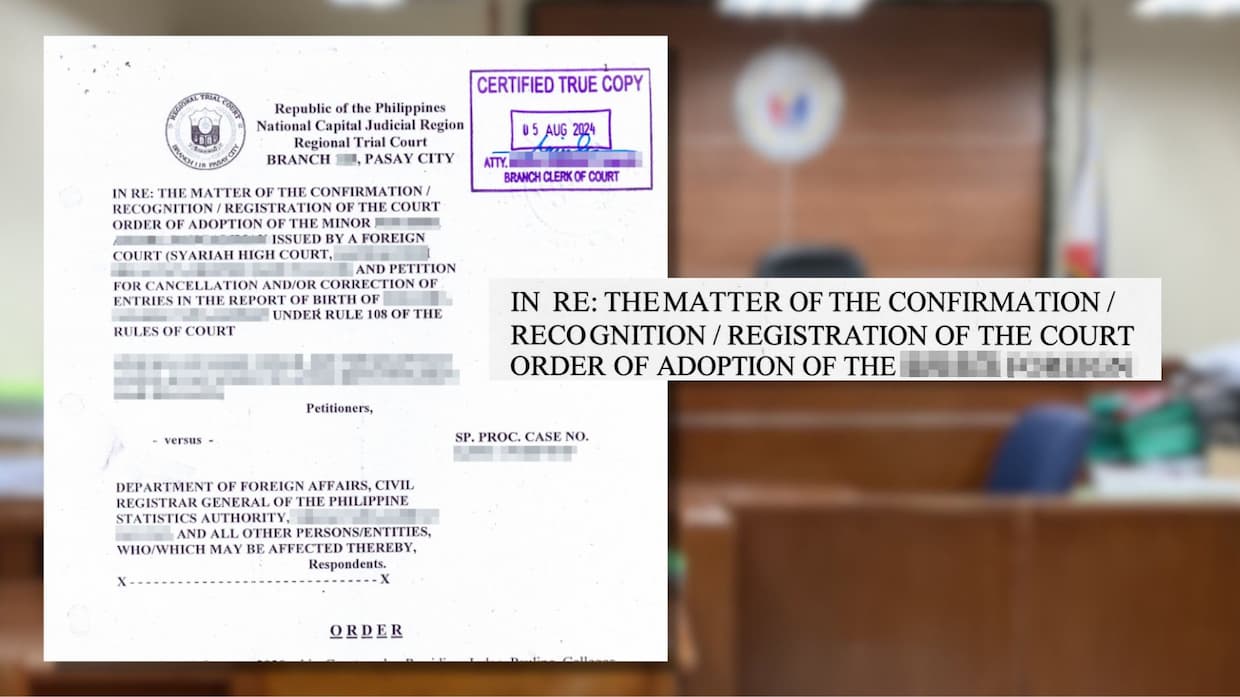

Is a US adoption valid in the Philippines?
Let us say that the adoption of a Filipino child took place in the United States or Canada or Europe for that matter.
Can that adoption be recognized in the Philippines so as to change the child’s status and parentage under Philippine law?
Yes, it can. Doing so requires a court case for its recognition and enforcement in the Philippines.

Send us an email with the details for
personalized recommendations or schedule a consulation if needed.

There are also bureaucratic requirements to consider after judgment, such as registration in the Local Civil Registry and with the Philippine Statistics Authority, to enforce the foreign judgment in the Philippines
The fact of the foreign adoption must be proved before a Regional Trial Court in the Philippines. A case for recognition of the foreign judgment must be filed, tried, and concluded.
For example, if the adoption took place in Japan or the United Kingdom, this needs to proved with sufficient evidence. The authenticated documents showing the adoption must be presented in accordance with the Philippine rules on evidence.
The RTC will then issue a decision granting recognition to the foreign adoption. It will order that amendments be made to the child’s Philippine birth certificate and other civil registry records.

Proof of the foreign adoption must be presented to the Philippine court.
Success at trial requires proving to the RTC that the foreign adoption actually took place and that it was validly obtained in accordance with the laws of the foreign country. Documentary proof must be submitted to the court, including the authenticated foreign court’s decision.
We have discussed this in detail in our other article on the topic.
The purpose of the case for recognition is not to relitigate the merits of the adoption that already took place, but to prove that it did and to determine whether or not to extend the effect of the foreign judgment to the Philippines.
Thus, in a case where a step-father adopted his Filipino wife’s child under the laws of New York or California, the validity of that foreign adoption decree must be established before a Philippine court. The adoption decree, apostilled in accordance with the Hague Apostille Convention where applicable, must be presented to the RTC. A competent witness must testify to the fact of the adoption having taken place.

The Supreme Court of the Philippines has upheld the recognition of foreign adoptions.
As early as 1967, the Supreme Court upheld the Philippine recognition and registration of foreign adoptions. It ruled that,
“We hold that an adoption created under the law of a foreign country is entitled to registration in the corresponding civil register of the Philippines. It is to be understood, however, that the effects of such adoption shall be governed by the laws of this country.”[i]
That case, Marcaida vs. Aglubat, involved the adoption of a Filipino in Madrid, Spain. The adoption had been ordered by the Spanish court and was sought to be recognized in the Philippines.
In Marcaida, the Supreme Court discussed the recognition in terms of private international law:
“Private international law offers no obstacle to recognition of foreign adoption. This rests on the principle that the status of adoption, created by the law of a State having jurisdiction to create it, will be given the same effect in another state as is given by the latter state to the status of adoption when created by its own law. It is quite obvious then that the status of adoption, once created under the proper foreign law, will be recognized in this country, except where public policy or the interests of its inhabitants forbid its enforcement and demand the substitution of the lex fori.”

The Supreme Court upheld its decision
The Court of Appeals has since made contradictory rulings on this question, but the Supreme Court upheld the principle conclusively in 2020.
In its definitive ruling in the case of Suzuki vs. Office of the Solicitor General,[ii] the Supreme Court rejected the argument that an adoption was only valid if made within the legal framework on adoption of either Republic Act No. 8043 (the Inter-Country Adoption Act of 1995) or Republic Act No. 8552 (the Domestic Adoption Act of 1998).
The Supreme Court ruled that the availability of the Domestic Adoption Act as a means to adopt a Filipino child should not automatically bar resort to recognition of the adoption decree obtained under Japanese law. The rules on domestic adoption should not be pitted against the recognition of a foreign adoption decree; instead, the better course of action is to reconcile them and give effect to their respective purposes.

Philippine courts will respect the judgment of a competent foreign court
Suzuki affirmed for foreign adoption cases the established international legal principle that final judgments of foreign courts of competent jurisdiction are reciprocally respected and rendered efficacious subject to certain conditions that vary in different countries.
The Supreme Court also laid down what proof is needed for the recognition of foreign adoptions. It emphasized in Suzuki that the recognition and enforcement of a foreign judgment or final order requires only proof of fact of such foreign judgment or final order. Furthermore, the recognition of the foreign judgment of adoption is a subsequent event that establishes a new status, right, and fact affecting petitioner. If duly proven, the foreign judgment needs to be reflected in the Philippine civil registry.
This is thus affirmed as the definitive rule for foreign adoptions:
A foreign adoption decree can be recognized and given effect in the Philippines once it is proven as a fact before a Philippine court.
[i] Marcaida vs. Aglubat, G.R. No. L-24006, November 25, 1967.
[ii] G.R. No. 212302, September 2, 2020.
In effect, an ICAB adoption is not the only way to adopt a Filipino child internationally.
The Supreme Court decision confirms that a foreigner can adopt a Filipino child through ways other than those provided in the Philippine Inter-Country Adoption Act or the Domestic Adoption Act. Such adoptions can still be recognized under Philippine law. This is momentous because it makes more adoptions possible.
There are conditions for adoption under the Philippine statutes which are often hard, or practically impossible, for a foreigner to fulfill.
For example, the Domestic Adoption Act requires a foreigner to reside in the Philippines for at least three years prior to filing for adoption. It also requires that he should maintain this residence until the adoption decree is finalized. This can be waived in some situations, but another, procedural condition for filing a petition for adoption is that it must be filed with a court in the Philippine city or province where the prospective parents reside. Many prospective parents who want to adopt a Filipino child cannot meet this residency requirement.

Philippine requirements for adoption are not the only consideration.
Take the case of a foreigner who wishes to adopt a Filipino child while they both live abroad. He or she thus cannot file an adoption case with a court in a Philippine city or province.
The Philippine Inter-Country Adoption Act, on the other hand, provides that “only a legally free child may be the subject of inter-country adoption.” By definition, a “legally-free child” means a child who has been voluntarily or involuntarily committed to the Department of Social Welfare and Development, in accordance with the Child and Youth Welfare Code. Thus, a Filipino who is not a “legally-free child” within the contemplation of the law may not be the subject of inter-country adoption.
However, if the foreigner adopts the child under his or her own country’s adoption law, that foreign adoption decree can now be recognized as valid and be given effect in the Philippines. The Domestic Adoption Act and the Inter-Country Adoption Act are not the only avenues for the valid adoption of a Filipino child.