How to file for Annulment in the Philippines while abroad
How to file for Annulment in the Philippines while abroad

If you need to know how to file for Annulment in Philippines while abroad, this article should provide you with all the information that you need.
I’m often asked by people, “Can I file for an annulment abroad?” or “Can I do the annulment process in the Philippines without appearance? or
Typically, people who ask this question are Overseas Filipino Workers (OFWs) with a Spouse in the Philippines.
While the process is generally the same with a few additional requirements,.
This article discusses:
- Residency Requirements for the Petitioner and Respondent;
- How to prove residency
- The Annulment Process when you’re overseas, including how to file and how Testimony is handled from abroad
- The Annulment Process if your Spouse is abroad and you are in the Philippines
- The Annulment Process in the Philippines without appearance
You’ll have a pretty good idea of whether or not you can file for Annulment abroad by the end of this article. You can also get in touch with us to discuss your particular concerns.

Send us an email with the details for
personalized recommendations or schedule a consulation if needed.

Caption Filing an Annulment case in the Philippines while living or working abroad is doable
Yes, you can file for Annulment abroad if you are not living in the Philippines at the time.
We are often asked about this by Overseas Foreign Workers (OFWs) who have worked in another country for years and who have a Spouse in the Philippines.
We also get asked by Filipino emigrants who were married in the Philippines and migrated abroad with their families. They may have then separated with one spouse returning to the Philippines to live.
Annulment while abroad is the correct case to file in these situations since both of the spouses are Filipino.
If one of the Spouses is a foreigner on the other hand, it is better to divorce abroad and then recognize this valid foreign divorce through a Recognition of Foreign Divorce court case.
[1] You can also file a case for Declaration of Nullity of Marriage.

Caption It is important to know the current addresses or the Residency of the Parties before filing an Annulment in the Philippines while living abroad.
An Annulment case can be filed from abroad as long as the other Spouse (the Respondent) has resided in the Philippines 6 months before the date of filing. The case must be filed in the province or city where one of the Spouses lives.
It is important to understand that an Annulment case filed at the wrong city or province will be dismissed by the court before it even goes to trial. That situation will
So, even if the Petitioner no longer lives in the Philippines, Annulment case can be filed in the Family Court of the Philippine province or city where the other Spouse lives.
The same applies to a Non-Resident who happens to be in the country. He can file for Annulment in the city where he or she may be found in the Philippines.
“The Petition shall be filed in the Family Court of the province or city where the petitioner or the respondent has been residing for at least six months prior to the date of filing. Or in the case of non-resident respondent, where he may be found in the Philippines, at the election of the petitioner.”
– Rule on Declaration of Absolute Nullity of Void Marriages and Annulment of Voidable Marriages
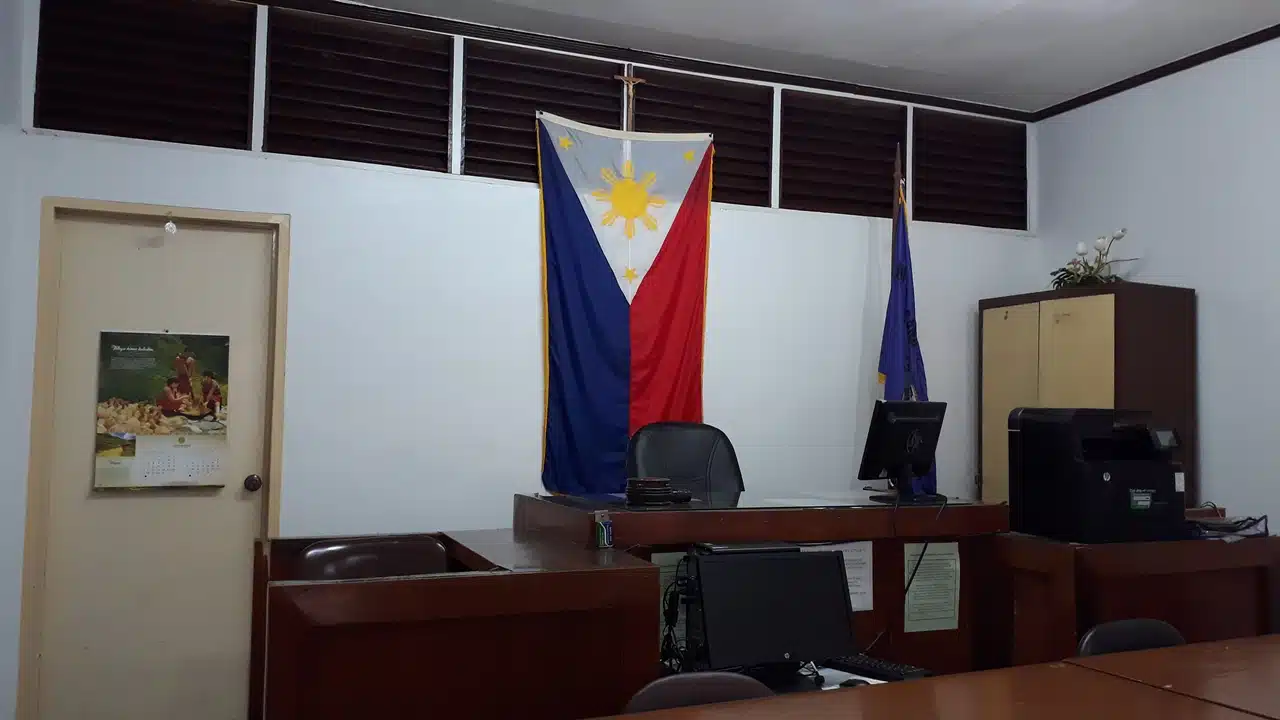 Caption Philippine Annulment cases are heard in the Family Court.
Residency Requirements for Annulment require that both Spouses current addresses are listed in the Petition for Annulment and that at least one of the Spouses has lived in a Philippine city 6 months prior to filing.
The court where the case is filed will check if these addresses are correct or true. The court verifies the addresses shortly after the Annulment case is filed. It sends a Notice and Summons to the other Spouse (the Respondent) at his given address through the Court Sheriff or the Process Server.
This Notice and Summons must be received by the Spouse so it is really important that the correct address is given.
If the court discovers that the addresses are not accurate or if one of the Spouses has NOT lived for 6 months in an area where the court has jurisdiction, then the court willdismiss the Annulment case outright.
If the court is able to verify the addresses and if one of the Spouses has lived for 6 months in an area where the court has jurisdiction, then the case will continue.

A house sketch can be added to the Sworn Certificate of Residency when filing for Annulment if it is certified by the appropriate authority.
The Petitioner must also show proof of where he or she lives. The Supreme Court has issued firm rules for proving the Petitioner’s residence.
Certificates of Residency from the Barangay or its equivalent, utility bills and bank statements in the Petitioner’s name are examples of proof of the Petitioner’s residency. A list of the documents needed for Proof of Residency when filing for Annulment in the Philippines is:
(1) Sworn Certification of Residency (with house location sketch) issued by the Barangay [or its equivalent if the Petitioner lives abroad];
(2) Sworn Statement of Counsel of Record that he/she has personally verified Petitioner’s Residency and that the Petitioner had been residing there for at least six (6) months prior to the filing of the Petition; and
(3) any, but not limited to, the following supporting documents:
- Utility bills in the name of the Petitioner for at least six (6) months prior to the filing of the Petition;
- Government-issued I.D. or Company I.D., bearing the photograph and address of the Petitioner and issued at least six (6) months prior to the filing of the Petition;
- Notarized Lease Contract, if available, and/or receipts for Rental Payments (bearing the address of the Petitioner) for at least six (6) months prior to the filing of the Petition;
- Transfer Certificate of Title, Tax Declaration, Deed of Sale and the like, in the name of the Petitioner where he/she resides
If the Petitioner is filing the Annulment while abroad, then the addresses shown would have to be his foreign address.
For the Respondent, the only requirement is the current address. Remember that this address must be accurate because the Court will check to see if the Respondent really lives there.
If the person filing the case (the Petitioner) is abroad, the Annulment process is generally the same except for the preparation of documents and the testimony of the Petitioner.
I’ll explain this in more detail in the following 3 sections:
1. How do I file for Annulment in the Philippines while I am abroad?
2. How can I sign the paperwork to file an Annulment in the Philippines if I am abroad?
3. Is there an Annulment Process in the Philippines without appearance?
The lawyer needs honest and complete answers in order to correctly assess an Annulment case in the Philippines.
If the person filing the case (the Petitioner) is abroad, the Annulment process is generally the same except for the preparation of documents and the testimony of the Petitioner.
I’ll explain this in more detail in the following 3 sections:
- How do I file for How to begin the process for Annulment in the Philippines while abroad?
- How can I sign the paperwork to file an Annulment in the Philippines if I am abroad?
- Is there an Annulment Process in the Philippines without appearance?
The lawyer needs honest and complete answers in order to correctly assess an Annulment case in the Philippines.
The lawyer needs honest and complete answers to correctly assess an Annulment case in the Philippines.
The first step is to engage a lawyer in the Philippines so that he can determine the correct grounds for Annulment and draft the necessary documents.
First, your lawyer will review the facts of your situation to determine the legal bases for a case of Annulment or Declaration of Nullity of Marriage. This includes making sure your grounds for Annulment are valid.
If you are not sure what the grounds for Annulment of Marriage in the Philippines are, you can check my article The difference between Legal Separation and Annulment in the Philippines for more information.
Communication and engagement with a lawyer here can be done remotely over video conference, email, Viber / WhatsApp, and other social media tools even if you are not in the Philippines.
The interviews that both the lawyer and the necessary Psychologist have to do with the client can be done over Skype, Zoom, or other platforms.
From these interviews, your lawyer will draft the Petition, the Affidavits, and the Authorization to appear on your behalf which have to be filed to initiate the Annulment case. These will then be emailed to you so that you can check and correct any details before you sign them and have them Notarized.
Your lawyer should also include instructions on how to authenticate these documents either through Consularization or through Apostille. Read more about this below.
You will then need to send these documents back to the lawyer via DHL or FedEx so they can be filed with the correct court.

Annulment documents and papers signed abroad have to be legalized in the country of origin and in the Philippines
The court documents prepared by your lawyer will need to be signed by you and Notarized.
The question thus becomes, how do you have these documents for an Annulment in the Philippines Notarized while abroad?
There are generally two options for how to do this.
One option is to go to the Philippine Embassy or Consulate where you are living and have your documents Notarized there. These documents will be considered validly Notarized for the Philippines.
Another option is to Apostille your documents.
So long as you live in an Apostille Treaty Member Country like the United States, Norway, or Japan, you can have your documents Notarized by a local Notary and then Apostilled in that country.
An Apostille is a special process of Authentication for international documents. A document authenticated in this way will also be deemed validly Notarized by the Philippines.
You can check to see if your country is an Apostille Treaty Member Country here.
You can discuss with your lawyer which option is more practical for you.

Remote hearings from abroad are possible if the Judge agrees and the Philippine Embassy where you live abroad offers Court videoconferencing services.
A question I have been asked a lot, particularly during the COVID pandemic, is what the Annulment process in the Philippines without appearance is. Or even, “Can I file an annulment abroad if I can’t come to the Philippines to appear?”
The answer is “Yes”. If the Judge allows videoconferencing Testimony and if there are Court Testimony Services available at the Philippine Embassy where you live, then you may be able to go through the annulment process in the Philippines without appearing.
allowing the Trial Courts to conduct video conference if the Judge agrees [1]
However, Testimony from abroad is only accepted by the Court if the Philippine Embassy where you live offers Court Testimony services.
Philippine Embassies do not always offer Court Testimony services because they may not have sufficient facilities or manpower. Philippine Embassies are slowly starting to roll out this service so frequent checking at the embassies is needed.
It is definitely a possibility that you can Testify through video conferencing from abroad but remember:
- The Judge has to agree
- The Embassy or Consulate has to offer Court Testimony Services
[1] Supreme Court Administrative Matter No. 20-12-01-SC (Re: Proposed Guidelines on the Conduct of Videoconferencing) dated December 9, 2020.
If you are in the Philippines and your Spouse is abroad, then the Annulment process is generally the same except that your Spouse will be Served Notice through the Hague Convention on Service. (Full title: The Convention on the Service Abroad of Judicial and Extrajudicial Documents in Civil or Commercial Matters)
The Hague Service Convention provides a common framework to serve court notices when Respondents and Petitioners of Civil or Commercial cases are in different countries from each other.
The Hague Service Convention requires that service be coordinated with the Resident Competent Authority. The Resident Competent Authority differs per country or per state (in the case of the United States).
Each Resident Competent Authority has different requirements.
It will take some work on your lawyer’s side to coordinate with them to determine exactly what is needed but it’s important to get this right. Service is a crucial part of a case.
Annulment cases require Residency Requirements, valid grounds for annulment and full compliance with the legal requirements.
A lot of work required in an Annulment case is detailed and often not seen by the client. It is important to choose a who does the work well.
Cases are won not only when the grounds are sufficient but also when the lawyer has fully complied with all the Court requirements.
Expect the court to take time as there are several Hearings for Annulment. This is because the Courts are very overworked and there can be months between Hearings.
If you are abroad, remember that the case can begin in court even while you are abroad. Just make sure that the correct venue requirements are met. The case can proceed even without you being in the Philippines for every single Hearing.
With the exception of document preparation and Testimony, the case is generally the same as if you were in the Philippines and so it should follow much of the same general pattern.
Atty. Francesco C. Britanico, FCB Law Office
Lawyers In the Philippines