Correcting your NSO Birth Certificate (3 Major Corrections Explained)
Correcting your NSO Birth Certificate (3 Major Corrections Explained)

This article covers everything you need to know about correcting your NSO Birth Certificate (now Philippine Statistics Authority).
This includes:
- How to correct the birth date in your birth certificate
- How to correct the name in your birth certificate
- How to change the gender in your birth certificate
Plus, I itemize the costs, timeline, process and requirements (with the exception of how to change the birth certificate of Illegitimate children, which I do not handle here) for both corrections you can do yourself and those for which you need to go to Court.
When the correction is successful, you will be able to order an annotated Birth Certificate showing the corrections.
When the correction is successful, a PSA Birth Certificate annotation will appear on any new copy ordered from the PSA.
If the birth was registered abroad or you are living abroad I recommend that you read Correcting your PSA Birth Certificate from abroad as well. The process for fixing your birth certificate is based on this local process so it’s important to know both.
Note changes of last name, year, parents or removal of a parent’s marriage are court cases.
For any questions, contact us here.

Send us an email with the details for
personalized recommendations or schedule a consulation if needed.
These annotations are usually made to reflect changes or corrections to the original document, such as changes in name, parentage, or other vital details
Let’s start with understanding annotated Birth Certificates.
An annotated birth certificate is an official document that displays any modifications made to your original birth certificate following the approval of corrections.
Such modifications may include changes to your name, date of birth, or gender.
An annotated birth certificate serves as evidence that the amendments have been duly acknowledged by the Philippine Statistics Authority (PSA). When you apply for a new copy of your birth certificate after corrections have been processed, the new document will feature annotations that specify these changes.
It’s important to note the specific requirements for correction of birth certificates, as these differ for each type of correction you wish to pursue regarding your birth certificate:
I’ve based this post on the Philippine Statistics Authority Guidelines for Birth Certificate Correction Requirements.
I’ve also added information from 4 first-hand accounts and 8 calls to various Local Civil Registrars and the Legal Department of the Central Civil Registrar.
In total, at least 78 hours have been spent on research and writing to provide you with fresh, new information that hasn’t just been copied from the Philippine Statistics Authority Website.
This article also sets out to summarize the different types of Administrative Proceedings.

We got our information about correcting Birth Certificates in the Philippines through 78 hours of research, calls and conversation.
There was some really great practical advice from the Local Registrars which I haven’t seen written about elsewhere.
1. As much as possible, file the correction at the Civil Registrar where your birth was recorded.
If you are not able to go in person you can give a relative a Special Power of Attorney (SPA) and photocopies of IDs and ask them to do it. However, a relative cannot do this for you if you need to change the gender on your birth certificate.
You can also go to your current local Civil Registrar but you will be billed a Migrant Fee (which is still a cost albeit a minimal one) and the process will take longer due to the coordination between the Local Civil Registrar of your Birth and your current Local Civil Registrar.
2. The first step is to figure out which Administrative Proceeding you need to do. There are three main Administrative Proceedings for a Birth Certificate Correction in the Philippines:
- Change of First Name;
- Correction of Clerical Error and
- Supplemental Report
I don’t include Illegitimate children in this article.
Each Proceeding has a different cost, timeline, set of requirements and process. It’s really important for you to know which one you fall under so that you don’t have many problems. (Check out our Quick Reference List.)
3. A maximum of 2 Supplemental Reports can be filed.
You will have to file for Correction of Clerical Error if there are more than two and the PSA Main will usually be asked to approve it.
4. If you are filing two requests together, you will only be charged the more expensive cost.
In the example I discussed with the Muntinlupa Civil Registrar, the 1,000 peso charge for the Correction of Clerical Error Petition was waived because the person was also filing a Petition for Change of First Name and this had a 3,000 peso charge.
5. If you are correcting your sex from male to female or from female to male, you must go to the Local Civil Registrar yourself.
This cannot be done by another person. However, you’ll only have to file a Supplemental Report if the sex has been left blank or both sexes are checked. (reference is a call with the Quezon City Local Civil Registrar)
6. Be prepared for variation; while the PSA has Guidelines, implementation is often uneven. I’d really urge you to call ahead regarding your particular circumstances.
7. Bring photocopies and originals, and note that for some cases it is much better if you have more documents than strictly required.
8. I’ve spoken to many Local Civil Registrars and done several corrections but I’d be happy to hear about other’s experiences. Send us an email and tell us about your experience.
Most people have no trouble with having an incorrect Birth Certificate until they interact with licensing bodies, the government or other countries.
It can often be only at times like these that they then need to correct their birth certificate.
For instance, people often correct their Birth Certificate because they plan to take the Board Exam.
The Professional Regulation Commission (PRC) is strict and requires your name to be exactly as it is spelled on your Birth Certificate.
In addition, passports and visas require the exact name and a complete place of birth to be on a Birth Certificate.
Big or substantive changes require a Court Proceeding. But it is these big changes which are even more important to do.
An incorrect Birth Certificate will affect Inheritances, Property Rights or benefits and must be fixed as soon as possible.
As such, you should really correct any errors or omissions in your Birth Certificate as soon as you can rather than wait until you really need to. This can really help to avoid problems down the line.
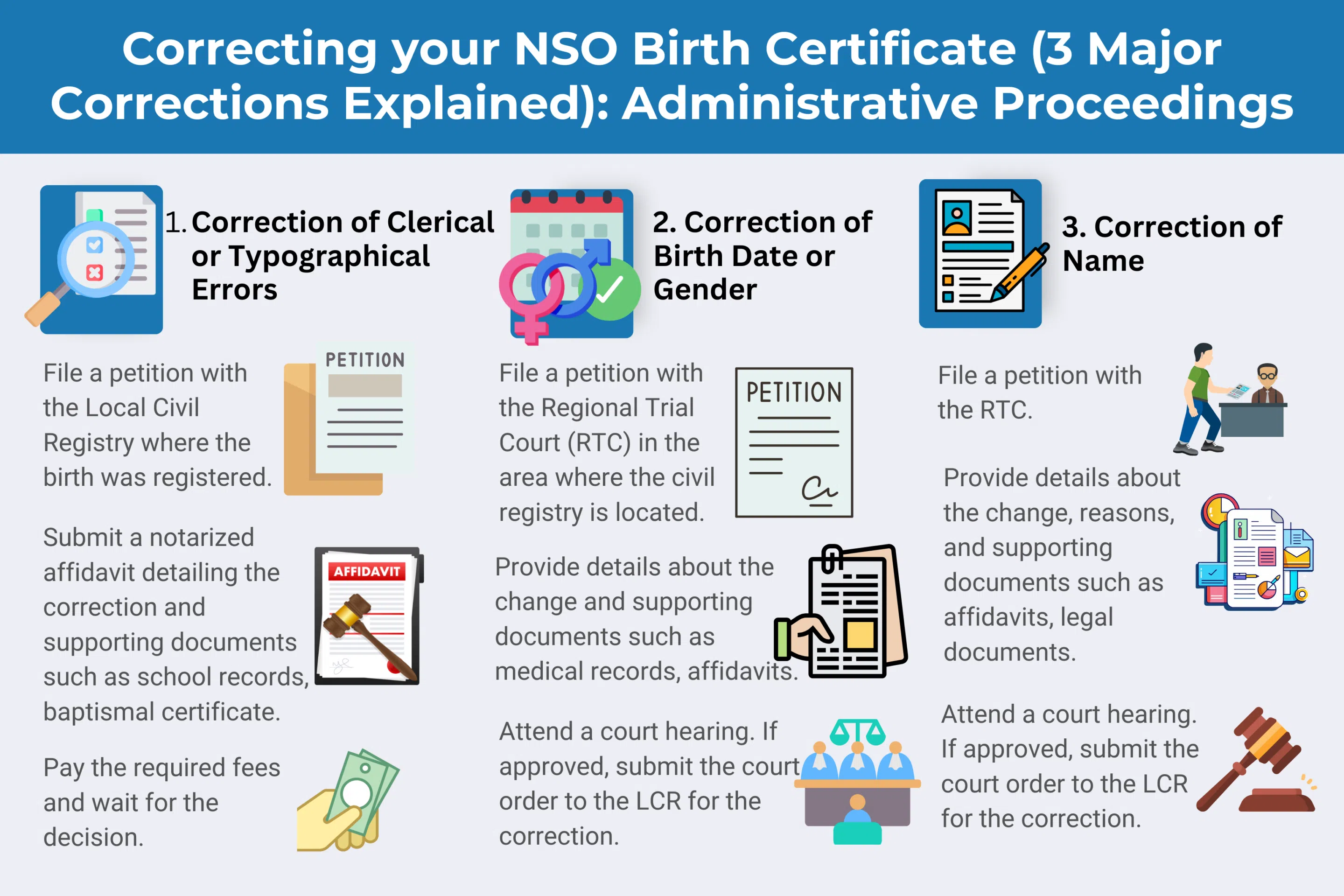
You can do the following PSA Birth Certificate Corrections in the Philippines yourself: first name, gender, typographical errors and birth month and birth day corrections. (RA 9048 and its amendment 10172)
I’ve compiled them into a Quick Reference List below:
1. Change of First Name
- First Name Used is Different from First Name on Birth Certificate
- First Name on Birth Certificate is Baby Boy, Baby Girl, Boy or Girl and the Child was Born 1993 onwards (Quezon City Local Civil Registrar stated this was Supplemental Report but PSA guidelines state otherwise).
2. Wrong Gender or Date of Birth (R.A. 10172)
- Wrong Gender is checked
- Day or Month of Birth is wrong
3. Correction of Clerical Error
- Blurred First, Middle or Last Name
- Mother’s Middle Name is Wrong and Child’s name is Correct
- Child’s Middle Name is Wrong and Mother’s name is Correct
- Wrong Spelling of First Name, Middle Name, Last Name
- Interchanged Middle and Last Name
- Middle Initial Entered Instead of Full Last Name
- Wrong gender checked (Muntinlupa Civil Registrar)
4. Supplemental Report
- No First Name, No Last Name, No Middle Name if Legitimate or No Middle Name if Illegitimate and Acknowledged by the Father
- First Name on Birth Certificate is Baby Boy, Baby Girl, Boy or Girl and the Child was Born before 1993
- No check mark for gender or both genders checked (as per Muntinlupa Civil Registrar)
- Illegitimate Child. While issues pertaining to an Illegitimate Child are an Administrative Proceeding they come under RA 9255 and I do not cover that in this article. RA 9255 allows the child to use the surname of his father but does not change the child’s status to Legitimate or Illegitimate as changes to status require a Court Proceeding.
If you don’t see the correction you need in this list, remember that Administrative Proceedings correct entries. This ranges from things as mundane as two letters being interchanged, or to the insertion of a missing syllable in a child’s last name while the other last names were correctly spelled.
As long as the error is clearly an encoding error and you’ve got supporting proof, a Petition filed directly with your Local Civil Register will succeed.
If you don’t find your change here, take a long hard look at your Birth Certificate. If you objectively think that it’s clear that an encoding error that was made, then you’d likely fall under a simple Administrative Proceeding.
Still not sure where you fall under?
Call the Legal Department of the Philippine Statistics Authority at +632-938-5273 and they’ll be happy to talk to you. I’ve spoken to them and they were remarkably helpful.
Or you might want to send a physical letter to Atty. Lourdines C. Dela Cruz, Director III, 4/F PSA-TAM Bldg., East Avenue, Quezon City, 1101.
Do not send an email – they’ve told me this sometimes gets lost.
(And yes, always follow up.)
If you don’t fall under any of these things and you’ve checked with the Legal Department of the Philippine Statistics Authority, check out our section on Judicial Proceedings.
Administrative Proceeding 1: Change of First Name
The process of how to correct your name in your Birth Certificate is something that you can do yourself by filing a Petition for Change of First Name. (Read Correction of Clerical Error to correct misspellings in your middle or last name and read Judicial Correction for any other issue.)
This corrects the first name on your Birth Certificate if it is different from what you habitually use or if it is “Baby Boy”, “Baby Girl”, “Boy” or “Girl” and you were born after 1993 (As per PSA Guidelines, but Quezon City Local Civil Registrar classifies it as a Supplemental Report).
A Change of First Name Petition requires the most documents and is the longest and most expensive Administrative Proceeding.
Still, it is far cheaper than going to court to get an annotated NSO Birth Certificate with your desired correction.

You can change your first name on your Philippine Birth Certificate by yourself.
Timeline: 4 to 7 months (or longer!)
Cost: 7,000 pesos or higher (3,000 for the Petition, 1,200 to 2,500 for Publication, and Notarization and other fees related gathering other requirements)
Requirements: Bring originals and several photocopies of the information required below.
As far as I can tell, you’ll really need to have all the documents, since this is one of the more stringent administrative cases. All documents should show the correct entry.
- Petition for Change of Name, notarized. You’ll get this at your Local Civil Registrar
- Philippine Statistics Authority Birth Certificate (SECPA)
- NBI Clearance
- PNP Clearance
- Certificate of Employment or Affidavit of Non-Employment
- Community Tax Certificate
- Baptismal Certificate
- School Record Form 137 / Diplomas and Transcripts
- Medical Certificate
- Any 2 Valid IDs: SSS, GSIS, Philhealth, Pag-ibig, Voter’s ID, Company ID, Drivers ID, PRC License, Land Title/Certificate of Transfer of Title, Bank Records and also Marriage Certificate
Just a note. In my conversations with the Local Civil Registrars, they told me that it is best to present as much proof as you can. The proof you present must show the correct information for the entry that you wish to have fixed. This helps your petition succeed.
Process: To correct the name in your Birth Certificate the process will be to first get the form at the Local Civil Registrar of your Birth and the checklist and make sure you are filing the right kind of Petition.
- You will then need to submit a Notarized copy with your attached documents.
- Pay your fees.
- Present your receipt, secure the Notice of Publication, and wait for the Local Civil Registrar to prepare your Petition.
- You will then have to wait for your documents to be posted for ten days and for your Petition to be published in a newspaper for two weeks. This can happen at the same time.
- You will get this Proof of Publication and your Endorsement from the Local Civil Registrar of your Birth and then send it off to the Office of the Civil Registrar General in Manila.
- It takes 1-3 months for the Central Civil Registrar to process this. It is advisable to follow up.
- After the Office of the Civil Registrar General affirms your Petition, you will send it back to your Local Civil Registrar for Certification.
- You will need to get the Certified Copy from your Local Civil Registrar and have it forwarded to the Philippine Statistics Authority (PSA) for them to record the change and provide an Annotated Birth Certificate.
- The going back and forth takes even longer if you do not start the process at the Local Civil Registrar of your Birth since they are really the ones who will make the adjustment.
- If your birth was reported to a Philippine Embassy and you are now in the Philippines, OR if you are abroad but your birth was reported to a local civil registrar in the Philippines, OR if you are abroad and your birth was reported abroad, you should read Correcting your Birth Certificate from abroad post. It deals specifically with these issues.
Websites that Help:
Administrative Proceeding 2: Change of Gender or Correction of Day or Month of Birth

You can also correct your gender and the month and day of your birth.
The process of how to correct your gender or correct the day or month of birth on your Birth Certificate in the Philippines is also an Administrative Process you can do yourself at the local Civil Registrar.
When your gender on your birth certificate is blank or both male and female are checked, you file a Supplemental Report.
I discuss Supplemental Reports in another section below.
When the wrong gender is checked on your birth certificate you file under R.A. 10172. You can also use RA 10171 to correct the birth date or month of birth of your Birth Certificate. (If you are trying to correct the year, you must file a Judicial Proceeding.)
The process for either correction is the same except that you will need to personally appear before an Accredited Government Physician if you are changing the gender on your birth certificate. There is usually one at your Local Registrar or you can ask them who you can go to.
The Accredited Government Physician is required to carry out a medical exam and confirm your biological gender. Their evidence must be included in the documents you attach to your Petition to change the gender on your Birth Certificate.
At the end of a successful process, you will be able to order an Annotated NSO Birth Certificate showing the correction.
Timeline: 4 to 7 months (and it may be longer!)
Cost: 7,000 pesos or higher (3,000 for the petition, 1,200 to 2,500 for Publication, and Notarization and other document related fees )
Requirements: Bring originals and several photocopies of the information required below. This is also a pretty stringent Administrative case and you should really prepare all your documents which should show the correct entry.
- Notarized Petition. You’ll get this at your Local Civil Registrar
- Philippine Statistics Authority Birth Certificate (SECPA)
- NBI Clearance
- PNP Clearance
- Certificate of Employment or Affidavit of Non-Employment
- Community Tax Certificate
- Baptismal Certificate
- School Records
- Medical Certificate
- Any 2 Valid IDs: SSS, GSIS, Philhealth, Pag-ibig, Voter’s ID, Company ID, Drivers ID, PRC License, Land Title/Certificate of Transfer of Title, Bank Records and also Marriage Certificate
Again, please present as much proof as you can.
Process: With the exception of also undergoing a medical exam from a Licensed Practitioner, the process is almost exactly the same as the process to correct a name in a Birth Certificate.
- Always call your local Civil Registrar beforehand to counter check.
- Again, I really suggest that you go to the Civil Registrar that your birth was reported to and file there. Otherwise it will be filed as a Migrant Petition and this will take much longer as the two different Registrars will need to coordinate and communicate.
- If your birth was reported to a Philippine Embassy and you are now in the Philippines, OR if you are abroad but your birth was reported to a local civil registrar in the Philippines, OR if you are abroad and your birth was reported abroad, you should read Correcting your Birth Certificate from abroad post. It deals specifically with these issues.
Administrative Proceeding 3: Correction of Clerical Error

You can correct Clerical Errors on a Birth Certificate in the Philippines, such as when a name is misspelled.
The answer to how to correct typographical or spelling errors on your PSA Birth Certificate is that you must file a correction of Clerical Error Correction at the Local Civil Registry. This can be done without a lawyer.
This corrects typographical mistakes, spelling errors or errors where someone clearly typed the information wrong.
Timeline: 2 to 5 months but this can vary
Cost: 1,000 for the petition but Notarization and other document processing fees may bring it up to 2,000.
Requirements: Documents needed are the Philippine Statistics Authority Birth Certificate (SECPA) and at least 2 of the following:
- Voter’s Affidavit
- Employment Record
- GSIS Record
- SSS Record
- Medical Record
- Business Record
- School Record
- Driver’s License
- Insurance
- Civil Registry records of ascendants
- Land Titles
- Certificate of Land Transfer
- NBI/Police Clearance
To be honest, given what I’ve seen of the Local Civil Registrars, I would advise presenting as many documents as you can that support your case. Some petitions do get disapproved, mostly for lack of convincing evidence.
Process: Go to the Local Civil Registrar and verify that a Correction of Clerical Entry Birth Certificate is what you need to file. Make sure to ask about the documents required.
- You’ll need to fill up the form, attach your documents, and submit this during your interview with the Local Civil Registrar.
- Pay the fees at local Treasury Office.
- Present your receipt at the Local Civil Registrar.
- Return to pick up your Approved Petition.
- Mail your Approved Petition to the Office of the Civil Registrar General and make sure you keep the receipt of the forwarder/courier together with the duplicate copy of the mailed documents.
- Follow up with the Local Civil Registrar for the decision of the Office of the Civil Registrar General. An Approved Petition will allow you to get a Certificate of Finality.
- Mail your Certificate of Finality to the Office of the Civil Registrar General along with additional records such as the Endorsement letter, etc.
- You can then get your Annotated Birth Certificate from the PSA
- If your birth was reported to a Philippine Embassy and you are now in the Philippines, OR if you are abroad but your birth was reported to a local civil registrar in the Philippines, OR if you are abroad and your birth was reported abroad, you should read Correcting your Birth Certificate from abroad post. It deals specifically with these issues.
First-hand Accounts and Websites that Help:
Administrative Proceeding 4: Supplemental Report

A Supplemental Report is the easiest way to address any blanks on your Birth Certificate.
The process of how to fill in a blank on your PSA Birth Certificate is through filing a Supplemental Report. A Supplemental Report is the fastest, cheapest and easiest way to correct blanks in your PSA Birth Certificate or in instances where both genders were checked.
You can do a maximum of 2 changes through a Supplemental Report but if there are more changes to be made you will have to file a Correction of Clerical Error Report.
Timeline: A month (usually)
Cost: 1,000 pesos approximately although it can be less.
Documents: Bring originals and photocopies of your NSO Birth Certificate and any 2 (although I know Makati requests 3) official documents that show the correct entry.
Depending on what you are trying to prove, the documents will change. Ask your Local Civil Registrar what is pertinent to your case before you go.
Documents needed are the Philippine Statistics Authority Birth Certificate (SECPA) and at least 2 of the below:
- Voter’s Affidavit
- Employment Record
- GSIS Record
- SSS Record
- Medical Record
- Business Record
- School Record
- Driver’s License
- Insurance
- Civil Registry records of ascendants
- Land Titles
- Certificate of Land Transfer
- NBI/Police Clearance
These are general requirements but I think these are the same for many others. Still, please check with your local Civil Registrar.
Process: Go to the Local Civil Registrar and verify that a Correction of Clerical Entry is what you need to file. Also ask for the documents required.
- Fill up the Supplemental Report and attach all your documents.
- Pay the fee.
- Submit the receipt.
- Your Local Civil Registrar will need to process your report, which you will need to pick up after a few days.
- Mail or personally submit the Supplemental Report to the Office of the Civil Registrar General.
- You can then already apply for your amended Certificate of Live Birth.
- If your birth was reported to a Philippine Embassy and you are now in the Philippines, OR if you are abroad but your birth was reported to a local civil registrar in the Philippines, OR if you are abroad and your birth was reported abroad, you should read Correcting your Birth Certificate from abroad post. It deals specifically with these issues.
First-hand Accounts and Websites that Help:
If your case doesn’t fit in anywhere or your Petition has been denied, you might have to think about going to court.
Judicial Proceedings cover the below items:
- Changes in birth year
- Substantial changes to your mother’s or father’s last names
- Nationality
- Anything affecting legitimacy such as whether your parents were married.
- Additionally, the law does not allow you to completely change your name as it only addresses encoding errors.
Essentially, when you start to hit things that have a profound bearing on your legal or Inheritance Rights or if you want to completely change last names, then a Judicial Proceeding in a court is necessary.
What are the documents you need to correct a Birth Certificate through Judicial Proceedings Philippines?
You will need to present government or institutional documents showing the correct data such as baptismal certificates, school records, marriage certificates, land titles and the like.
The more documents, pertinent information and evidence you present to correct a Birth Certificate through Judicial Proceedings Philippines the better.
As an example: if you’re trying to correct your birth certificate to show your father was an American citizen, you’ll have to present documents that prove that.
Your father’s passport and your siblings’ Birth Certificates would be great supporting information in that case.
There will definitely be other documents that you should prepare, but you get the picture.
Take note that all persons who may have an interest in these proceedings will need to be informed of this process.
This is a very firm requirement under Rule 108 of the Rules of Court and it cannot be waived. The case may not succeed otherwise.
What is the Court Process for Judicial Proceedings to correct a Birth Certificate Philippines?
After gathering your documents, you’ll need to engage a lawyer to draft your Petition for Judicial Proceedings to change your Birth Certificate.
The Petition will be signed by the lawyer and sworn to by you, the Petitioner.
It will then be filed in the appropriate branch of the Regional Trial Court with its supporting documents. Next it will be raffled to a branch of the Regional Trial Court.

You and your lawyer will go through several steps to correct your Birth Certificate at court
The Petition will be published in a random newspaper once a week for three weeks.
The lawyer will present to the Court the Proof of Publication (newspaper) and Proof of Notice to the required parties on the first Hearing date. These will then be marked into the court’s record.
The evidence will be presented on the subsequent Hearing dates.
The witness can be a relative or yourself and often may only require a written Affidavit to attest to the authenticity of the documents.
All persons who have a claim or interest need to be formally informed of the court process.
For instance, if you want to change the name of your father on your Birth Certificate, you are going to have to inform your father, your siblings, the Civil Registrar, etc.
Additionally, this type of Proceeding can even be done while you are abroad so long as you have the documents and someone to attest to their authenticity.
How long do Judicial Proceedings take to correct a Birth Certificate?
When it comes to Judicial Proceedings to correct a Birth Certificate you should expect a case to take about a year to a year and a half. It may take longer should the case be more complicated and especially if one of the Respondents opposes the case.

Judicial Proceedings can take 1 year to a year and a half to conclude
The reason that the case may take this long is that all the parties interested must be Notified and that the Petition must be published in a newspaper (Proof of Publication).
The process of raffling to the newspaper, arranging publication and then presenting this proof in court takes up time. The simple act of informing all parties interested in the case also takes up time.
In addition, a Petition for Change of Name requires that a Hearing does not take place within 4 months after the last Publication Notice in the newspaper, further extending the process.
You may have also have heard that Philippine Courts are very clogged. This is unfortunately very true. Hearings may be months apart.
Due to this and other side issues, the Court process is expected to take up the entire year or year and a half.
You should present the full case and all facts to your lawyer to ensure that the process is as quick as can be.
Your lawyer can then minimize side issues and plan the work effectively so as to get it done in the least amount of time.
How much does a Judicial Hearing to correct a Birth Certificate cost in the Philippines?

Cost will be charged over the year and are due to court, publication and lawyer fees.
When it comes to Judicial Proceedings to change a Philippine Birth Certificate you will have to prepare a certain amount for court Fees.
These may include the initial Filing fee and Sheriff’s fees. There are photocopying costs, postage and notarization fees.
You will also have to prepare for newspaper fees to comply with the three-week Publication requirement.
Your lawyer’s professional fees will include an Acceptance fee, where he commits to study the case, provide advice on what evidence to present and forgo other cases for your case. Often, this will depend on how complicated a case may be. Some cases can really be quite involved.
Subsequent fees are Pleading fees and Court Appearance fees. The cost for this depends on how involved the pleadings are or how far the Court is and are often agreed upon when you initially consult with your lawyer.
No, under RA 10172 Implementing’s Rules and Regulations you can only change your gender on your Birth Certificate if it was entered incorrectly.
The Republic Act No. 10172 amended Section 1 of this Amendatory Law states, “No entry in a civil register shall be changed or corrected without a Judicial Order, except for clerical or typographical errors and change of first name or nickname, the day and month in the date of birth or sex of a person where it is patently clear that there was a clerical or typographical error or mistake in the entry, which can be corrected or changed by the concerned city or Municipal Civil Registrar (C/MCR) or Consul General in accordance with the provisions of this Act and its implementing rules and regulations.”
You cannot change the gender on your birth certificate in the Philippines because you are Transgender or have undergone Sexual Reassignment surgery.
The Philippine Supreme Court ruled that a Filipino who is transsexual or who has undergone sexual reassignment surgery cannot legally change their sex on any official documents, which includes a Birth Certificate.
Notable Cases:
2007 case of Silverio v. Republic (Name and Gender Change on Birth Certificate Philippines)
The Petition to change the gender and name on her Birth Certificate, from Rommel Jacinto to ‘Mely’, was initially granted by her local Civil Registry. Mely had already undergone Sex Reassignment Surgery.
However, the Republic of the Philippines, via the Office of Solicitor General (OSG), filed a Petition for certiorari. A certiorari allows for a superior court to reexamine a ruling made by a lower court. The Court of Appeals overturned the earlier ruling and denied Silverio’s Petition.
The Supreme Court Ruling stated: “While petitioner may have succeeded in altering his body and appearance through the intervention of modern surgery, no law authorizes the change of entry as to sex in the civil registry for that reason. Thus, there is no legal basis for his petition for the correction or change of the entries in his birth certificate.”
The 2008 case Republic v. Cagandahan (Name and Gender Change on Birth Certificate Philippines) was slightly different.
Jeff Cagandahan Petitioned to change both name and gender on his birth certificate.
Whilst born with visible female genitalia, at the onset of puberty Cagandahan began to also develop male characteristics due to Congenital Adrenal Hyperplasia (CAH). Armed with the documents required, medical diagnosis and Psychiatrist evidence Jeff successfully petitioned to have his name and gender changed on his birth certificate.
In this case the Supreme Court ruled “Sexual development in cases of intersex persons makes the gender classification at birth inconclusive. It is at maturity that the gender of such persons, like respondent, is fixed. Ultimately, we are of the view that where the person is biologically or naturally intersex, the determining factor in his gender classification would be what the individual, like respondent, having reached the age of majority, with good reason thinks of his/her sex”.
2018 Republic v. Bringas (Name and Gender Change on Birth Certificate Philippines) was a partial success for Pat Bringas.
Born male but identifying as female Pat Bringas Petitioned the Civil Registry Office, Manila to change both her name and gender on her Birth Certificate.
The Civil Registry Office under RA 9048 and its Amendment 10172, granted the name change but not the gender change. RA 9048 and its Amendment 10172 allows for a name change if the “First Name Used is Different from First Name on Birth Certificate”.
Pat’s name on her Birth Certificate was Patrick but she was able to successfully prove that the name everyone used was Pat.
She called on her parents, family members and friends as Witnesses to evidence this. With documentary evidence she was able to win her Petition to change the name on her Birth Certificate.
But she was not successful in her Petition to change the Gender on her Birth Certificate for the same reasons as the 2007 Silverio case.