Cancellation of Encumbrance Under Section 7 of R.A. No. 26 (Removing the “Reconstituted Title” Annotation)
Cancellation of Encumbrance Under Section 7 of R.A. No. 26 (Removing the “Reconstituted Title” Annotation)
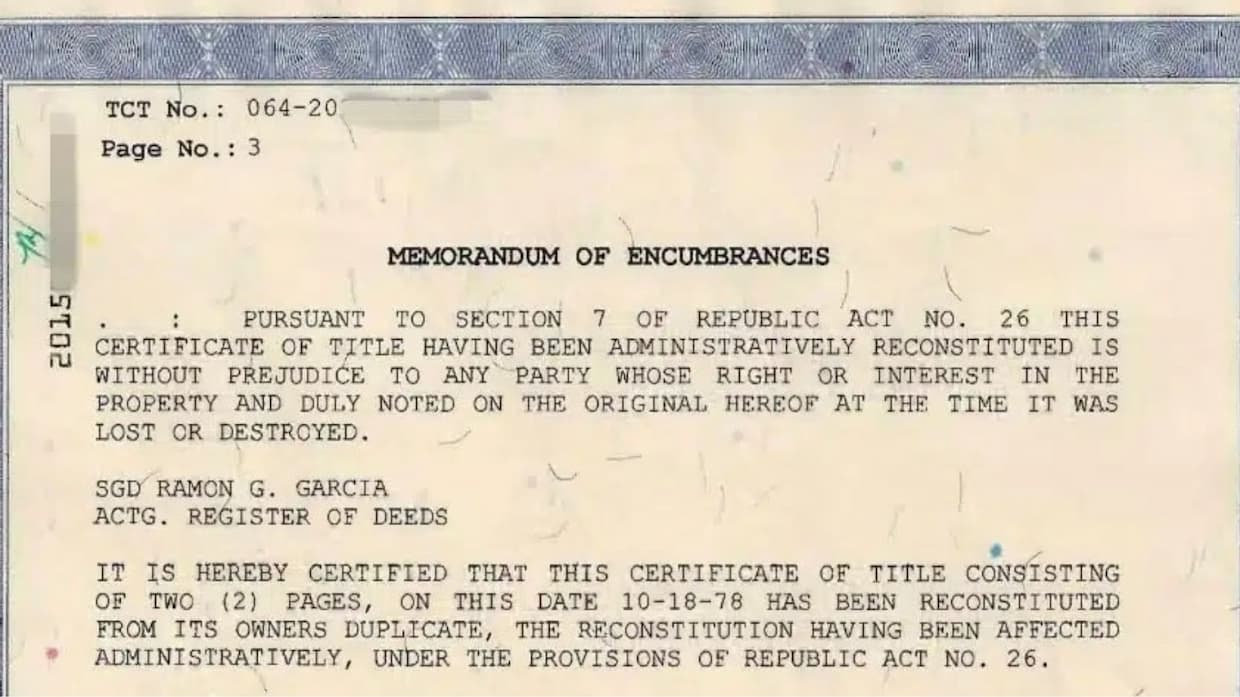

A reconstituted title is a title that replaced a missing Original Title in the RD.
Land titles that have been reconstituted to replace missing originals often carry a Section 7 annotation under Republic Act No. 26.
This annotation appears directly on the title and signals that the Registry copy was recreated, which can raise concerns for buyers, lenders, and institutions.
Removing the annotation is important because a “clean” title reassures third parties that there is no hidden risk to the property.
If the annotation remains, it may lower market confidence, slow down transactions, or reduce financing opportunities.
To “clean” the title and remove the annotation, property owners need to go to court—just like with any other encumbrance—so the title looks complete and trustworthy again.
In this article, we discuss what this annotation means in real life, why it affects property transactions, and how the law provides remedies for its cancellation.

Send us an email with the details for
personalized recommendations or schedule a consulation if needed.
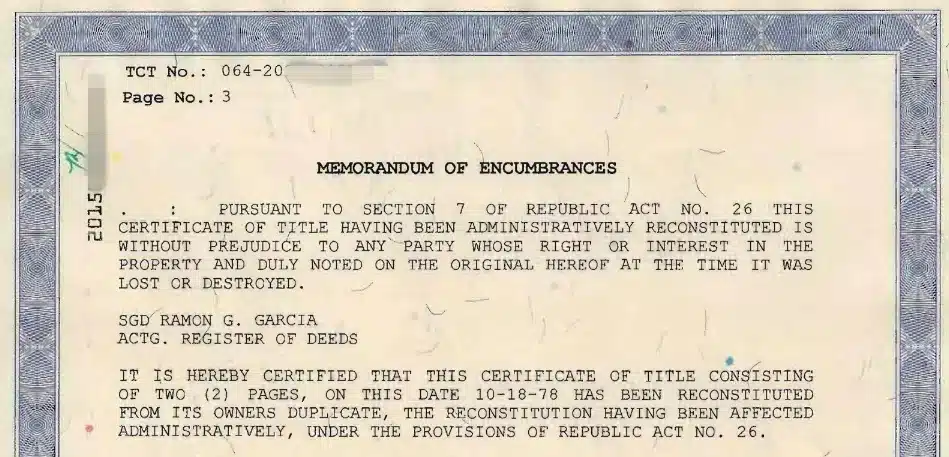
One title can have several encumbrances depending on the situation
A reconstituted title is a title issued to replace the Registry of Deeds’ missing or destroyed original record of your OCT/TCT.
In many cases, the owner still holds an Owner’s Duplicate, but banks, buyers, and developers still want the Registry copy to exist and match because the Registry copy is the public record that confirms ownership and prior annotations.
When the Registry copy is reconstituted through administrative (extrajudicial) reconstitution, the title typically carries an annotation under Section 7 of Republic Act No. 26.
This annotation is a warning that the title was recreated and that some rights or interests that were duly noted in the lost original might not have been carried over into the reconstituted certificate of title.
This is why serious buyers and lenders often ask to “clean the title.”
A Section 7 annotation tends to reduce market confidence, slow down transactions, and make due diligence harder—especially when the property is being sold, leased long-term, used as loan collateral, or contributed to a development project.
Email admin@lawyerphilippines.org with a clear photo of the title (front and back) so we can check the annotations and advise on the fastest lawful route to remove the Section 7 encumbrance.

Encumbrance acts as a warning to potential buyers that the property is not clean
A Section 7 annotation usually means the Registry of Deeds’ original title was administratively reconstituted.
The law treats reconstituted titles as valid, but Section 7 imposes a two-year reservation “without prejudice” to parties whose recorded rights were omitted during reconstitution.
Section 9 of R.A. 26 provides the court procedure to cancel the annotation after statutory notice, and it also allows cancellation by ex parte motion after two years if no Section 8 petition was filed within that two-year period. Most delays come from missing documents or defective publication/posting, not from the merits.
Email admin@lawyerphilippines.org and we’ll tell you whether you likely qualify for an ex parte cancellation or need a full petition with hearing.
Courts are overloaded with cases so expect the process to take some time
A Section 7 annotation is an encumbrance placed on certain reconstituted certificates of title to reserve and protect any right or interest that was duly noted on the lost or destroyed original title but was not carried over to the reconstituted title.
- An encumbrance refers to any claim made against a property that may hinder its transferability (for example, a mortgage, a lien, an adverse claim, or a statutory reservation like Section 7).
- Section 7 commonly appears on administratively (extrajudicially) reconstituted titles—reconstitution done under Sections 5 and 6 of R.A. 26.
- The reservation under Section 7 is effective for two (2) years from issuance of the reconstituted title, and it is noted as an encumbrance on the title.
- One title can have several encumbrances depending on the situation; cancelling Section 7 only removes that specific statutory reservation.
TLDR: the Section 7 annotation is a legal warning that the Registry record was recreated and that omitted recorded rights may still be asserted during the reservation period.
Action: Have a lawyer review the exact wording of the annotation on your title so you don’t use the wrong remedy for the wrong annotation.

Registry of Deeds secures land ownership by recording, safeguarding, and issuing property titles.
You have a Section 7 annotation because the Registry of Deeds’ original copy of your title was lost or destroyed, and the title was reconstituted through an administrative (extrajudicial) process where the law requires a reservation to protect omitted recorded rights.
- Property owners seek reconstitution because even if you have the Owner’s Duplicate, missing Registry records can be challenged and can block financing or sale at full value.
- R.A. 26 covers reconstitution of Torrens titles that were lost or destroyed; after reconstitution, the Register of Deeds issues a reconstituted title intended to match the original.
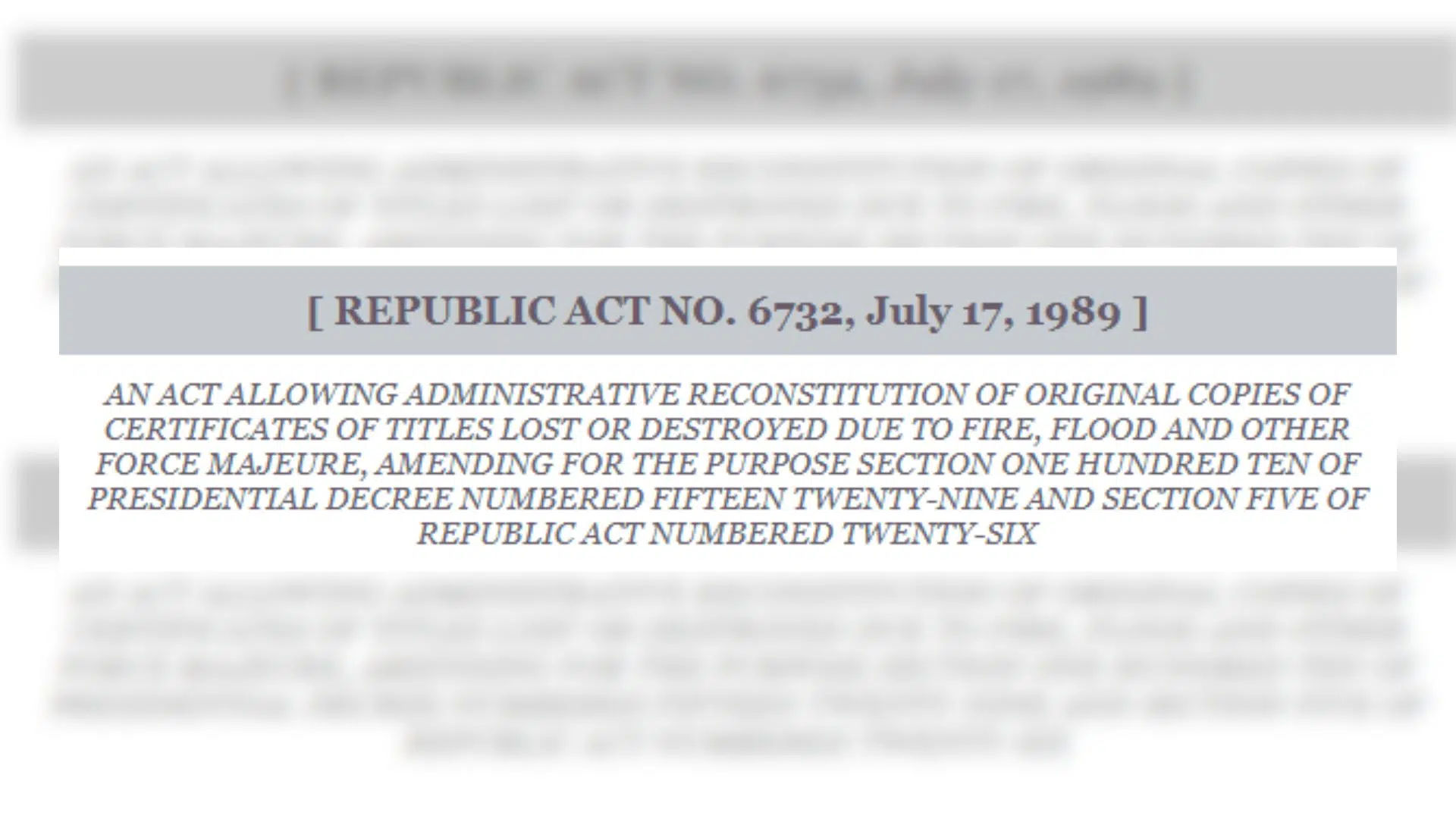
- R.A. 6732 allows administrative reconstitution in certain cases of massive loss/destruction of titles due to force majeure, when at least 10% of titles or at least 500 titles in the Registry are lost or destroyed.
- The Section 7 reservation exists because incomplete sources or clerical errors can cause missing annotations, so the law leaves a window for restoration of omitted recorded rights.
Bottom line: the Section 7 annotation informs 3rd parties that the title was reconstituted and it signals a transaction risk that many buyers and lenders do not want to assume, which is why people ask that it is removed.
Action: Before negotiating with buyers or banks, secure a certified true copy (front and back) from the Registry of Deeds and compare it with your Owner’s Duplicate.
RA?26 protects property rights by reconstituting lost or destroyed land titles, keeping ownership valid.
The key legal basis is Republic Act No. 26: Section 7 creates the reservation/encumbrance on administratively reconstituted titles; Section 8 allows omitted rights to be annotated while the reservation subsists; and Section 9 provides the procedure to free the title from the Section 7 encumbrance, including an ex parte cancellation route after two years if no Section 8 petition was filed within that period.
- R.A. 26, Sec. 7: creates the “without prejudice” reservation for extrajudicially reconstituted titles and requires it to be noted as an encumbrance.
- R.A. 26, Sec. 8: allows a person whose right was duly noted in the original but omitted in the reconstituted title to petition the court to have it annotated.
- R.A. 26, Sec. 9: allows the registered owner (or an annotated mortgagee/lessee/lien holder) to seek cancellation; after two years, the court shall cancel on ex parte motion if no Sec. 8 petition was filed within that period.
- R.A. 26, Sec. 22: petitions under the Act are generally filed/entitled in the land registration or cadastral case where the decree was entered (with special rules if the case number can’t be identified).
- R.A. 6732: governs administrative reconstitution in cases of widespread title loss/destruction (10% or 500-title threshold).
TLDR: The laws that the Section 7 encumbrance and its cancellation are RA 26, Sec 7 and RA 6732.
Action: Bring your title and reconstitution details to a property lawyer so you can confirm (1) whether Section 7 applies, (2) whether the two-year window has lapsed, and (3) the correct court filing for your facts.

Land title stays encumbered if not canceled.
If you do not cancel the Section 7 encumbrance, the title remains “flagged” as reconstituted, which can lower market value, slow down sales, and trigger stricter requirements from banks and institutional buyers who prefer clean titles.
- Challenges in selling or transferring ownership because buyers may treat the annotation as a risk marker.
- Possible legal conflict if a third party asserts an omitted recorded right within the reservation period.
- Reduced bankability: lenders may require cancellation before approving a loan, or demand additional safeguards.
TLDR: A Section 7 annotation can lower sale value and cause banks and other institutions to hesitate with transact with you using the title.
Action: If you plan to sell, mortgage, or develop the property, begin the title-cleaning process early so the annotation does not become a last-minute deal breaker.
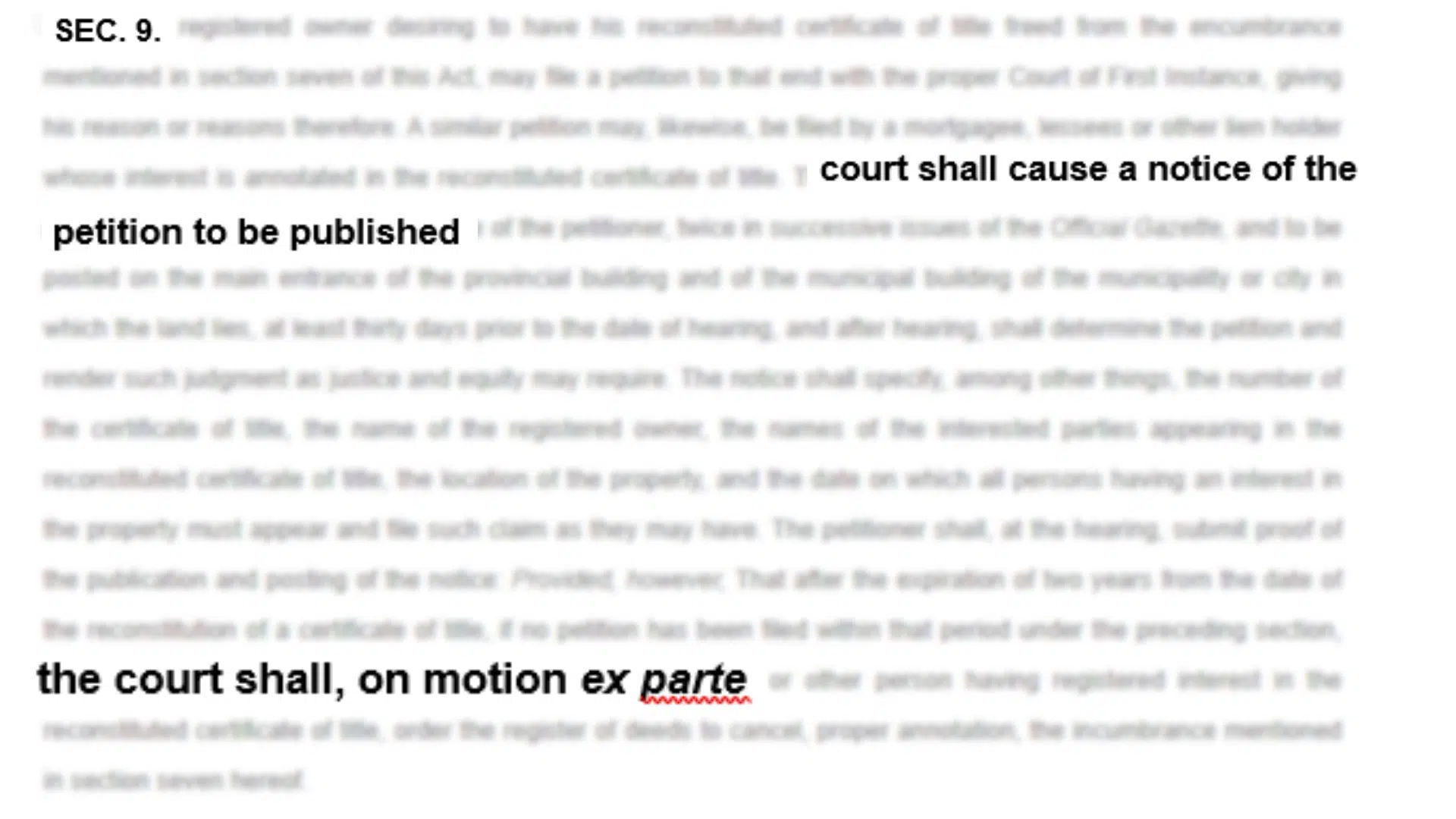
Court cancels encumbrance via hearing or ex parte.
Under Section 9 of R.A. 26, there are two main court routes: (1) a petition with notice, publication, and hearing; and (2) after two years, an ex parte motion if no petition under Section 8 was filed within that two-year period.
- Route 1 (petition + hearing): the court sets a hearing and causes statutory notice; any interested person may appear and contest.
- Route 2 (ex parte after two years): if the two-year reservation has expired and no Sec. 8 petition was filed within that window, the court shall cancel the encumbrance on ex parte motion.
- Both routes still require a court order; the difference is whether you must go through publication/hearing or qualify for the shorter ex parte route.
TLDR: The only way to cancel a Section 7 encumbrance is through court.
Action: Confirm the reconstitution date on the title and check other annotations so you don’t assume Section 7 cancellation will “clean everything.”
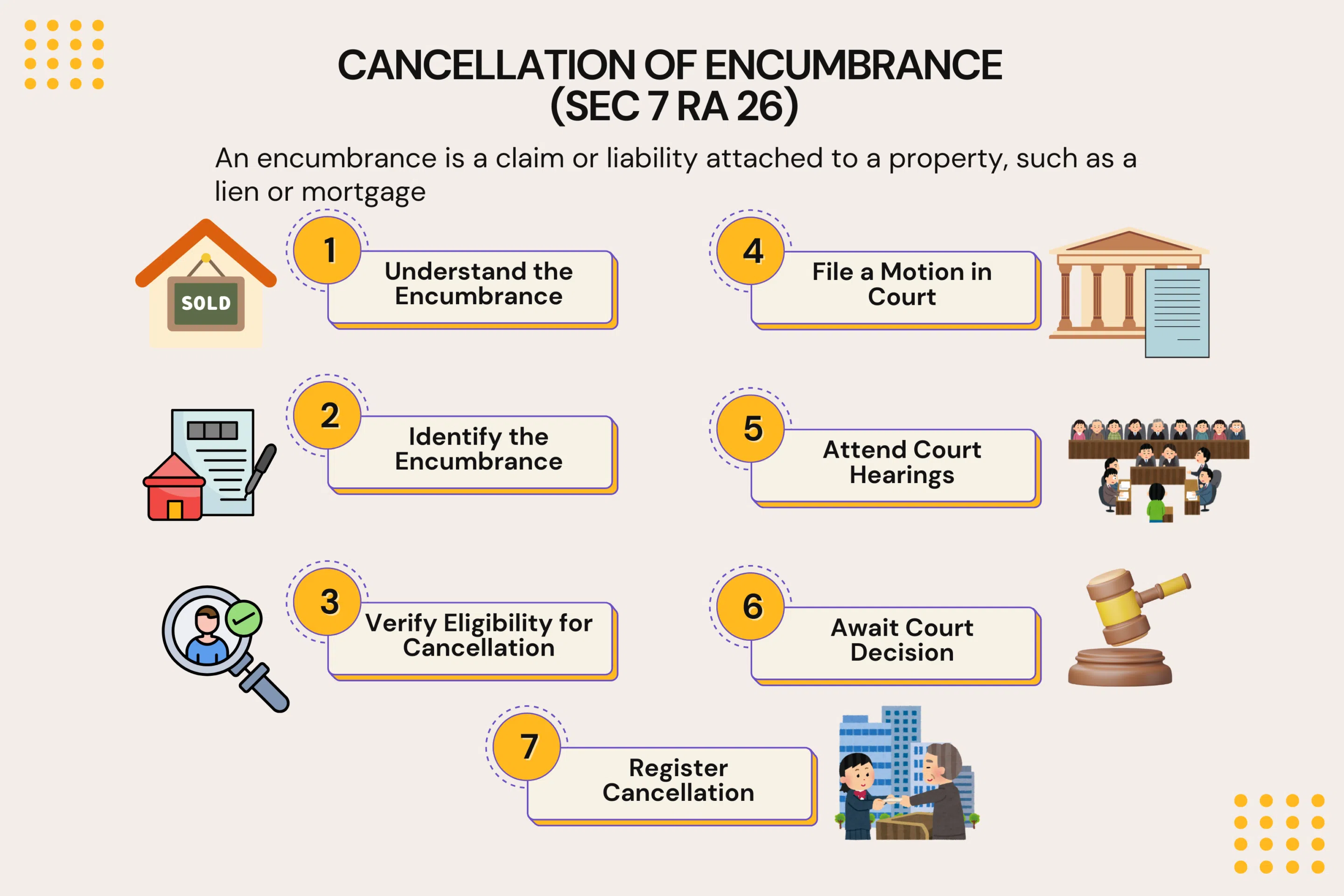
Cancelling an encumbrance under Section 7 RA 26 follows the same process as cancelling other encumbrances.
A standard Section 9 petition involves drafting and filing the petition, completing statutory publication and posting at least 30 days before hearing, presenting proof of compliance and your evidence at hearing, and then registering the court decision/order at the Registry of Deeds so the title is updated.
- Legal consultation and title diagnosis: confirm the mode/date of reconstitution and list all annotations on the encumbrance page.
- Draft the petition: counsel prepares the petition stating the reasons for cancellation and your standing.
- File in the proper case framework: R.A. 26 petitions are generally filed/entitled in the land registration or cadastral case where the decree was entered (or per the special rule when the case number cannot be identified).
- Publication and posting: notice is published twice in successive issues of the Official Gazette and posted at the provincial building and the municipal/city building where the land is located, at least 30 days before the hearing.
- Hearing: present proof of publication/posting and documentary evidence; oppositors may present claims.
- Decision/order and Registry update: register the order/decision with the Registry of Deeds so the Section 7 annotation is cancelled.
TLDR: To remove a Section 7 encumbrance, you will need to go through the full court process: filing the case, going to all the hearings and then registering a successful decision.
Action: Ask counsel to create a publication/posting calendar before filing so you don’t lose time (and money) repeating notice steps.

Your goal is to prove what the annotation says, when and how the title was reconstituted, that you have standing, and that the statutory conditions for cancellation are met (including the lapse of time if you will use the ex parte route).
- Certified true copy (CTC) of the OCT/TCT from the Registry of Deeds, including the encumbrance page with the Section 7 annotation.
- Owner’s Duplicate Certificate of Title.
- Registry certifications or the reconstitution order showing the date and whether reconstitution was administrative or judicial.
- If heirs/representatives file: supporting authority documents and proof of relationship (exact documents vary by situation).
- If ex parte after two years: proof of reconstitution date and record checks supporting that no Section 8 petition was filed within the two-year period.
TLDR: Complete documentation keeps the case moving so ensure that you have all the property documents to prove your claims. Incomplete or mismatched title details often lead to a reset hearing and repeat publication.
Action: Before spending on Official Gazette publication, have your lawyer review your title scan and reconstitution details so the petition’s facts are accurate and complete.

Challenges and problems are inevitable, so plan ahead.
Most problems are procedural: wrong case caption, incomplete notice details, defective publication timing, or failure to prove publication/posting at the hearing.
Courts treat notice requirements strictly because R.A. 26 proceedings affect the public and third parties.
- Notice details that do not match the certified true copy (title number, owner name, land location, and interested parties appearing on the title).
- Publication timing issues (not published twice in successive Official Gazette issues, or not posted/published at least 30 days before hearing).
- Failure to submit proof of publication and posting at the hearing date.
- Mismatch in names or technical description compared to the title entries.
- Other encumbrances remain (e.g., adverse claim or mortgage); cancelling Section 7 does not cancel these.
TLDR: Issues with notice details, publication, information inconsistences can delay the case.
Action: Have your lawyer double-check the notice content against the certified true copy before publication is ordered.
 Case complexity determines both the time and expenses involved.
Timeline and costs vary by court docket, the Official Gazette publication schedule, and whether you qualify for an ex parte cancellation after two years.
- Time drivers: court calendars, Official Gazette release schedules, posting periods, and whether oppositors appear.
- Common expenses: Official Gazette publication, obtaining certified documents from the Registry of Deeds, and professional fees.
- Avoidable delays: incomplete documents and publication defects are common reasons cases restart or extend.
TLDR: A Section 7 RA 26 removal of encumbrance takes about a year to a year and a half from filing to decision if it is not challenged and costs include lawyer’s fees as well as publication and processing fees – expect about Php 200,000 at least but this varies a lot by situation.
Action: If you have a deadline (sale closing, loan release), recognize that these may have to be pushed back due to the hearing schedule.

Supreme Court provides guidance on disputes tied to encumbrances.
Jurisprudence explains why the Section 7 annotation exists, why courts require strict compliance with notice rules in R.A. 26 proceedings, and it confirms the ex parte cancellation route after the two-year period in appropriate cases.
- Republic v. Patricio B. Bella (G.R. No. 260831, Feb. 26, 2025): recognizes that the Section 7 encumbrance in an administratively reconstituted title may be cancelled under Section 9, including cancellation by ex parte motion after two years if no Section 8 petition was filed within that period.
- Register of Deeds of Malabon v. RTC, Malabon (G.R. No. 88623, Feb. 5, 1990): stresses the jurisdictional importance of proper publication in R.A. 26 proceedings (publication defects can derail the case).
Action: Be aware of the legal landscape any decisions that may affect it.

Ensure all documents are complete for a seamless process.
Start with a title diagnosis: confirm whether the title was administratively reconstituted, identify the reconstitution date, and list every other annotation on the encumbrance page.
From there, decide whether you qualify for an ex parte cancellation after two years or must proceed with a Section 9 petition with publication and hearing.
- Secure a certified true copy of the title (front and back) from the Registry of Deeds.
- Confirm the mode and date of reconstitution (administrative vs judicial).
- Check for other annotations (mortgages, adverse claims, lis pendens) that will not disappear even if Section 7 is cancelled.
- Consult counsel to choose the correct route and build a publication/posting calendar that fits your deadlines.
TLDR: A little upfront checking often saves months of delay – talk to a lawyer for assessment first.
Action: Email admin@lawyerphilippines.org if you want a lawyer to review your title and map the fastest lawful route to cancellation.